
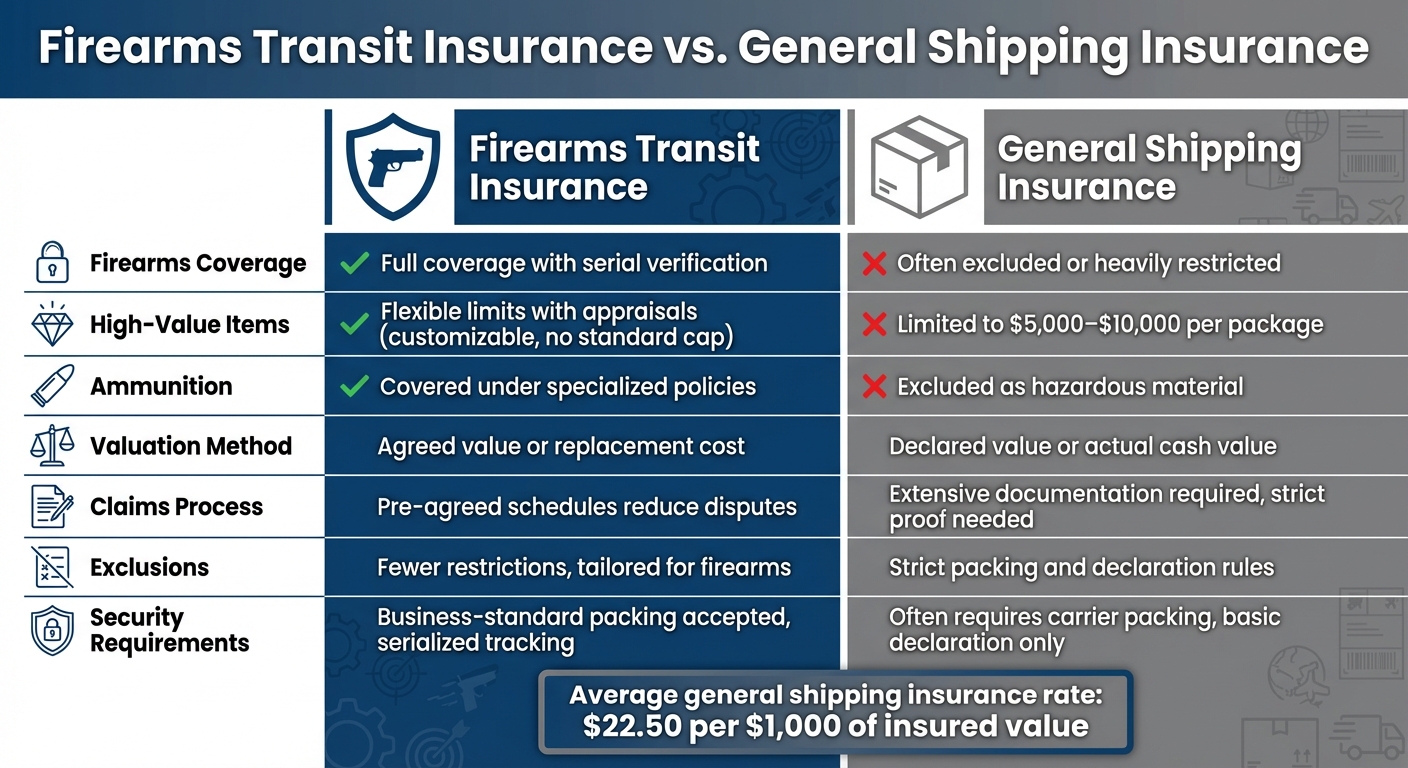
When shipping firearms, relying on general shipping insurance can leave your business exposed to risks like theft, loss, or damage. Firearms transit insurance, on the other hand, is specifically tailored to cover firearms, serialized parts, and ammunition, addressing the unique challenges and regulations of the firearms industry. Here's a quick breakdown:

If your business involves shipping firearms or related inventory, firearms transit insurance provides the protection and flexibility general shipping insurance lacks. Take time to review your current policies and ensure your shipments are fully covered.
Let’s take a closer look at how firearms transit insurance is tailored to meet the specific needs of the firearms industry.
Firearms transit insurance is a specialized form of cargo insurance that provides protection for firearms, serialized parts, and ammunition during transportation. Whether shipments are moving from manufacturers to distributors or from distributors to FFL dealers, this coverage addresses risks like theft, collisions, fires, rough handling, and accidental drops - hazards that standard carrier insurance often excludes [1][2].
For U.S. manufacturers and importers, this insurance covers both domestic and international shipments, regardless of the transit method used. Agencies like Joseph Chiarello & Co., Inc. offer customized policies specifically for FFLs and firearms businesses, ensuring inventory remains protected throughout the shipping process [1][2].
This level of tailored coverage becomes even more critical when dealing with high-value and collectible firearms.
Standard carrier insurance typically limits coverage to just a few thousand dollars per package, which can leave high-value firearms inadequately insured. Firearms transit insurance addresses this issue by offering flexible coverage limits, scheduled coverage options, and agreed-value settlements. Businesses can list specific high-value items - such as rare Winchester Model 1873 rifles or custom collectibles - along with appraisals to guarantee full replacement value without disputes over depreciation [1][3].
For collectible firearms, claims usually require a recent professional appraisal, while new inventory claims can often be supported with distributor invoices [3].
Firearms transit insurance is designed to work seamlessly alongside Firearms Business and Property Insurance, providing continuous coverage without gaps. While business property insurance protects inventory stored at fixed locations like shops, warehouses, or ranges, transit insurance kicks in as soon as the goods leave those premises. This coordination ensures firearms are covered both in storage and on the move [1][2].
Joseph Chiarello & Co., Inc. structures their firearms business packages to integrate transit coverage with other essential protections like general liability, products liability, workers' compensation, and auto insurance for vehicles transporting firearms. This comprehensive approach simplifies claims management, aligns coverage limits with shipment values, and reduces the complexity of juggling multiple policies [1].
Next, we’ll explore how these specialized policies differ from general shipping insurance to better understand their unique advantages.
General shipping insurance from major carriers like USPS, UPS, and FedEx is designed to protect everyday items - such as electronics, clothing, books, and household goods - against loss, damage, or theft during transit. These policies are geared toward standard consumer shipments and don’t address the unique needs of specialized or regulated items like high-value firearms shipments.
While standard carrier insurance is sufficient for most commercial shipments, it often excludes or imposes strict limitations on high-risk or regulated items. Firearms and ammunition, for instance, are typically classified as prohibited or restricted under these policies. This creates a notable coverage gap, leaving sellers financially exposed until the items reach their destination. Such limitations highlight the need for more tailored protections when dealing with regulated or high-value goods.
General shipping insurance policies usually cap coverage at $5,000 per package, with premium rates averaging $22.50 for every $1,000 of insured value. For businesses shipping high-value firearms or collectibles, this coverage limit can be a serious drawback. Even when carriers offer declared value coverage, they impose strict requirements. For example, new firearms may require distributor invoices, while collectibles demand professional appraisals - online auction printouts or screenshots from platforms like GunBroker are not accepted. Additionally, inadequate packaging often leads to automatic claim denials, making specialized packaging essential for high-value shipments.
Filing a claim involves detailed documentation, which must be submitted within 60 days. Shippers are required to provide proof of value, photos of any damage, and evidence of proper packaging. Claims are frequently denied if the packaging is deemed inadequate, with carriers often insisting that they perform the packing to meet their standards. For firearms, which are commonly classified as prohibited items, this often means they are entirely ineligible for coverage. Furthermore, claims generally exclude consequential damages and losses involving high-risk or improperly secured items, adding another layer of complexity for shippers handling regulated goods.
When it comes to shipping firearms, the choice between firearms transit insurance and general shipping insurance can have a big impact on both risk and cost. Let’s break down the key differences.
One of the main distinctions lies in what each type of insurance actually covers. General shipping insurance typically classifies firearms as restricted items. Many carriers outright refuse to insure firearms under their standard policies, leaving you to shoulder the risk until the package arrives. Even when coverage is offered, it often excludes serialized parts and ammunition.
On the other hand, firearms transit insurance is specifically designed to cover firearms, serialized parts, accessories, and sometimes even ammunition. It applies to shipments within the U.S. and internationally, whether you're sending items between business locations, to customers or licensed dealers, or even to events like gun shows.

These differences highlight why firearms transit insurance is often better suited for businesses dealing with firearms and related items.
How items are valued during claims is another critical difference. General shipping insurance usually bases its valuation on declared cash value, often with low limits. Carriers typically require extensive documentation, such as distributor invoices or professional appraisals, and they rarely accept evidence like online auction printouts.
Firearms transit insurance, however, often uses an agreed value or replacement cost approach, particularly for high-value or collectible firearms. Unlike general policies, firearms transit insurance doesn’t impose a standard cap, allowing coverage limits to reflect the true value of your inventory. This flexibility helps prevent disputes over value when filing a claim.

This tailored valuation approach ensures firearms transit insurance aligns with the unique needs of firearms businesses.
Both types of insurance exclude claims related to improper packing or lapses in security, but the specifics differ significantly. General shipping insurance often denies damage claims unless the carrier handles the packing. It also excludes unattended vehicle theft and shipments that fail to meet firearm declaration rules.
Firearms transit insurance, while maintaining strict security standards, is generally more flexible. Policies require the use of locked vehicles, secure premises, and proper packing, but they also accept business-standard packing methods. Additionally, these policies often include built-in security measures like serialized tracking and concealed packaging. The underwriters and adjusters handling these policies are experienced in managing firearms-related risks.

General shipping insurance often leaves shippers vulnerable to claim denials if packing standards aren’t met. Firearms transit insurance, however, provides protection that’s better suited to the specific risks and value of firearms shipments.
Selecting the right insurance policy is a crucial step in managing risks effectively, especially in an industry as specialized as firearms.
When deciding between firearms transit insurance and general shipping insurance, it’s important to evaluate your business’s specific needs. Start by looking at the value of your shipments. If you frequently ship high-value or collectible firearms, general shipping insurance might not cut it - most policies cap coverage at around $5,000 per shipment. Also, consider how often and how far you ship. Businesses that regularly transport firearms - whether to Federal Firearms License (FFL) holders, warehouses, or directly to customers - can benefit from specialized transit insurance designed for routine operations.
Take a close look at your existing commercial and inland marine policies to spot any gaps in transit coverage. Many mainstream insurance providers avoid working with firearms businesses, leaving critical risks unaddressed. Regulatory compliance is another key factor. If your business involves imports or requires strict adherence to ATF regulations, you’ll need coverage tailored to meet these unique challenges - something generic shipping insurance often doesn’t provide.
Firearms transit insurance becomes essential when shipping high-value or collectible firearms that exceed the limits of standard carrier policies. It’s also a smart choice for businesses like manufacturers, importers, distributors, and FFL dealers who frequently move inventory between locations or ship directly to customers. If you handle international shipments, particularly ocean cargo from overseas suppliers, specialized transit insurance is indispensable. General shipping policies often fail to cover the unique risks associated with international transport.
For businesses managing large inventories on the move - whether it’s shipments to gun shows, inter-store transfers, or deliveries from warehouses - firearms transit insurance offers the kind of tailored protection that generic policies often overlook or inadequately cover. This specialized coverage ensures your business is protected against industry-specific risks.
Joseph Chiarello & Co., Inc. specializes in providing insurance solutions tailored to firearms businesses, including comprehensive transit coverage for both domestic and international shipments. Their policies address the specific gaps and regulatory challenges faced by the industry. Additionally, their offerings integrate seamlessly with broader business insurance needs, such as Commercial General Liability, Workers' Compensation, and commercial auto insurance for vehicles used to transport firearms.
Having the right coverage is crucial to keeping your firearms business protected when the unexpected happens. General shipping insurance often falls short for firearms businesses, with coverage limits as low as $5,000 per shipment or outright exclusions for firearms altogether [3,4].
Specialized firearms transit insurance, on the other hand, is tailored to the specific needs of the firearms industry. It provides coverage for firearms, parts, and accessories without the exclusions common in standard policies. These policies also offer higher coverage limits that reflect the true value of your inventory and are supported by underwriters who are familiar with ATF regulations and FFL operations. High-value and collectible firearms, in particular, are better protected under specialized policies, which often include agreed-value methods or appraisal-based coverage to address their unique market value [2,4]. This type of insurance is an essential part of a well-rounded risk management strategy.
Take a moment to review your current policies and address any gaps before losses occur.
Start by auditing your current shipping and insurance practices. Look at how your firearms are transported - whether through USPS, UPS, FedEx, private carriers, or your own vehicles. Check the coverage limits and exclusions in place, and consider how often high-value items are shipped [2,4]. Identifying these gaps will help you make informed decisions and avoid leaving valuable shipments underinsured.
Joseph Chiarello & Co., Inc. offers a detailed review of your overall risk profile. Whether your business involves manufacturing, importing, distributing, retailing, or gunsmithing, they can help you integrate transit insurance with your property, liability, and workers' compensation policies [1]. With their expertise in firearms businesses across the U.S., they understand ATF regulations, shipping practices, and common claim issues. Schedule a consultation to ensure your transit coverage aligns with industry standards and regulatory requirements [2,3].
Firearms transit insurance is crafted to tackle the distinct risks tied to moving firearms, including theft, loss, or accidental damage. While general shipping insurance offers broad protection, it often falls short when it comes to addressing the specific liabilities or higher value that firearms typically carry.
By opting for specialized firearms transit insurance, you gain the assurance of knowing your shipment is protected with coverage designed specifically for the unique challenges of transporting firearms. This tailored approach makes it a dependable choice for securing high-value firearms during transit.
The claims process for firearms transit insurance is built to handle the specific challenges of transporting firearms. It usually involves submitting detailed documentation, such as evidence of proper handling, secure shipping methods, and compliance with federal laws. These extra steps are necessary to ensure claims are handled correctly and adhere to strict legal standards.
On the other hand, general shipping insurance takes a more straightforward approach, focusing on everyday goods. Claims typically require checking shipping conditions, delivery records, and reports of damage or loss, without the added firearm-specific requirements. This difference highlights why firearms transit insurance is so important for businesses in the firearms industry - it provides tailored protection designed specifically for their unique needs.
Firearms transit insurance offers protection tailored to the specific risks involved in shipping firearms, including loss, theft, or damage during transit. Unlike standard shipping insurance, it focuses on the unique requirements of securely and legally transporting firearms.
This coverage complements other firearms-related policies, such as business insurance, property coverage, and liability protection. When combined, these policies provide a well-rounded safeguard for firearms businesses, protecting your assets throughout every step of the shipping process.
Don't wait until it's too late to make sure your gun shop is covered. At Joseph Chiarello & Co., Inc., we’re here to help you navigate the ins and outs of gun shop workers compensation insurance to ensure you're prepared for any noise-related risks, including hearing damage. Reach out to us today to review your current policy or get a customized quote. Protect your team and your business with the right coverage—because their safety is worth it.
Call Now: 800-526-2199. Or submit your inquiry below. We look forward to having the opportunity to work with you!