

When running a firearms business, standard insurance often doesn’t cover unique risks like theft, fire, or compliance issues. Tailored insurance is essential to protect your building, inventory, and operations. Here’s what you need to know:
Partnering with an insurance specialist ensures your policy addresses industry-specific risks, helping you recover quickly from potential losses.
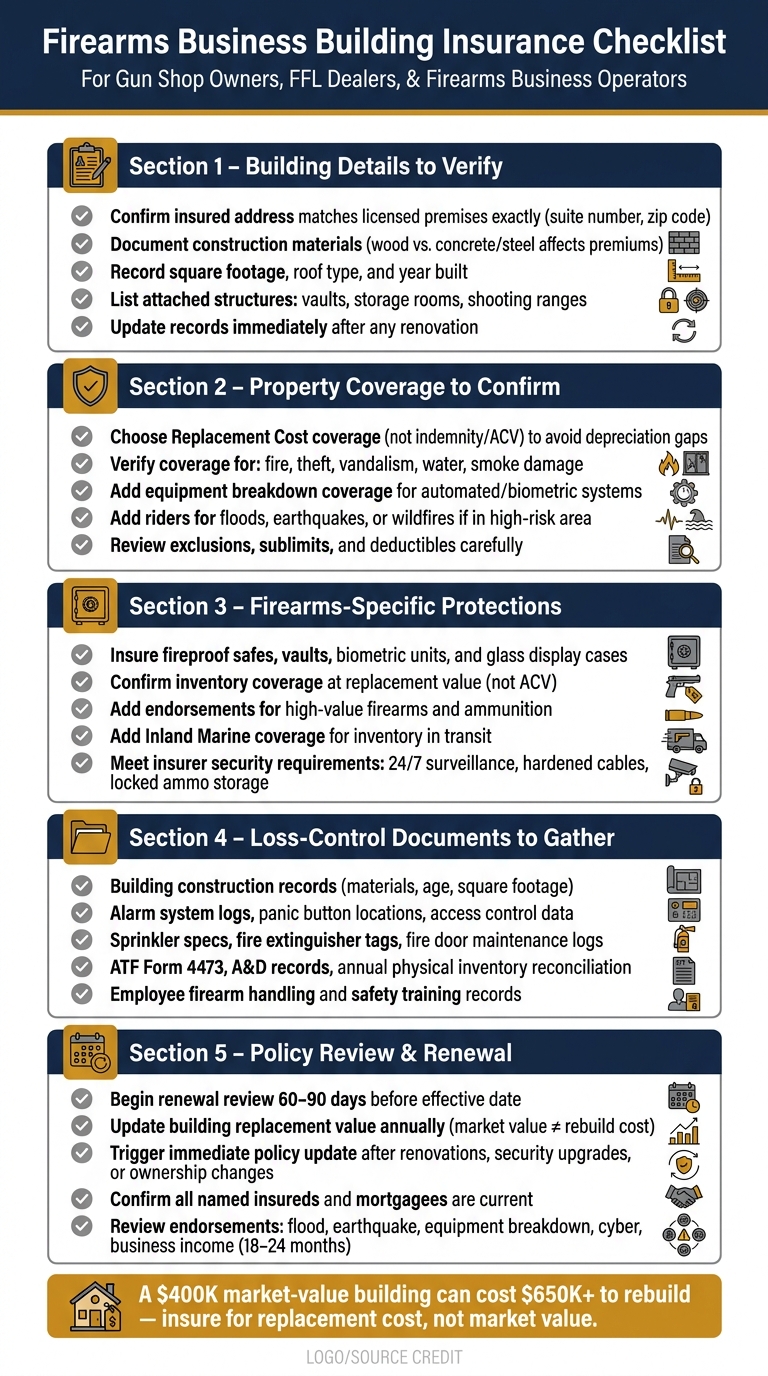
Providing a complete and up-to-date property profile is essential for avoiding coverage gaps. Accurate details not only help reduce delays in claims processing but also ensure your business is fully protected. Missing or outdated information often becomes a problem only when it’s too late - after you file a claim.
Double-check that the policy address matches your licensed premises exactly. This means including details like suite numbers, zip codes, and building names. Additionally, ensure the policy reflects the correct ownership or lease structure. For example, if the property is co-owned, leased, or held under an LLC, all relevant parties must be listed correctly.
"Choosing the right insurance coverage can make all the difference in ensuring your safety and financial stability in the firearm industry." - Joseph Chiarello & Co., Inc. [1]
Even small discrepancies - like a missing suite number or an incorrect zip code - can lead to complications when filing a claim. Keep ownership and lease records updated whenever changes occur. These details are the foundation of solid, reliable coverage.
Insurers rely on specific building details - such as construction type, square footage, roof type, and the year the building was constructed - to calculate premiums and assess risk. Accurately documenting this information is critical.
The type of construction material can significantly impact your premiums. For instance, buildings made of wood or other flammable materials pose a higher fire risk and often lead to higher insurance costs. On the other hand, structures built with concrete or steel are generally considered less risky. Older buildings may also require extra coverage due to potential structural issues or outdated systems.
"The type of construction and age of the building are critical factors in determining insurance premiums for firearms businesses." - Joseph Chiarello & Co., Inc. [2]
If renovations are made, update your records right away. Incorrect square footage or outdated classifications can leave your business underinsured. Additionally, document any extra structures or unique areas on the property to ensure comprehensive coverage.
For firearms businesses, it’s vital to list attached structures and specialized areas - like storage rooms, vaults, or on-site shooting ranges - separately. Each of these areas comes with its own risks and may require specific coverage.
Take a shooting range, for example. It introduces liability risks related to customer injuries that a basic property policy may not cover. Similarly, a vault or secure storage room could be a high-value target for theft, requiring additional protection. Collaborate with a firearms insurance specialist to ensure every part of your property is accounted for, and document the unique features of each area. This not only helps in obtaining accurate coverage but also streamlines claims processing if a loss occurs.
Making sure your policy addresses all relevant risks is crucial. This step builds on the detailed property profile you've already put together, and many firearms business owners only realize they have coverage gaps after a loss has occurred.
Understanding the difference between replacement cost and indemnity policies is essential. A replacement cost policy reimburses the full cost to rebuild at today’s prices, including extras like fencing, outdoor lighting, and signage. On the other hand, an indemnity policy only covers the depreciated value of the property [1][6].
For firearms businesses, this distinction is especially important since secure construction and specialized infrastructure can be costly to replace. Factors like construction materials, building age, occupancy type, and the proximity to fire hydrants all influence replacement costs [3]. Partnering with a firearms business insurance specialist, such as Joseph Chiarello & Co., Inc., ensures these factors are carefully evaluated during underwriting. This way, your coverage limits will accurately reflect the true cost of rebuilding.
Once you’ve ensured replacement cost coverage, verify that the policy addresses all potential risks. Make sure it includes protection against fire, theft, vandalism, water, and smoke damage.
"Smoke and water are deceptively destructive, so even if the flames don't touch some parts of the building or your inventory, repairs or cleanup will probably be needed." - Doug Larson, Insurance Expert [4]
Additionally, check for equipment breakdown coverage, which safeguards against internal mechanical or electrical failures. This is especially relevant if your facility uses automated systems or specialized machinery [4]. If your building is in an area prone to floods or earthquakes, consider adding specific riders or endorsements to fill those gaps [5][1].
Exclusions, sublimits, and deductibles can hide potential coverage gaps. A sublimit restricts the payout for specific types of losses, even if your overall policy limit is higher. Meanwhile, a high deductible can make it less practical to file smaller claims.
For example, "Acts of God" clauses in some policies may exclude wildfires, categorizing them as events beyond human control [3]. If your property is in a wildfire-prone area, confirm whether this peril is covered. Documenting security upgrades like reinforced storefronts or biometric safes can help you negotiate for better terms, such as lower deductibles or higher sublimits [2].
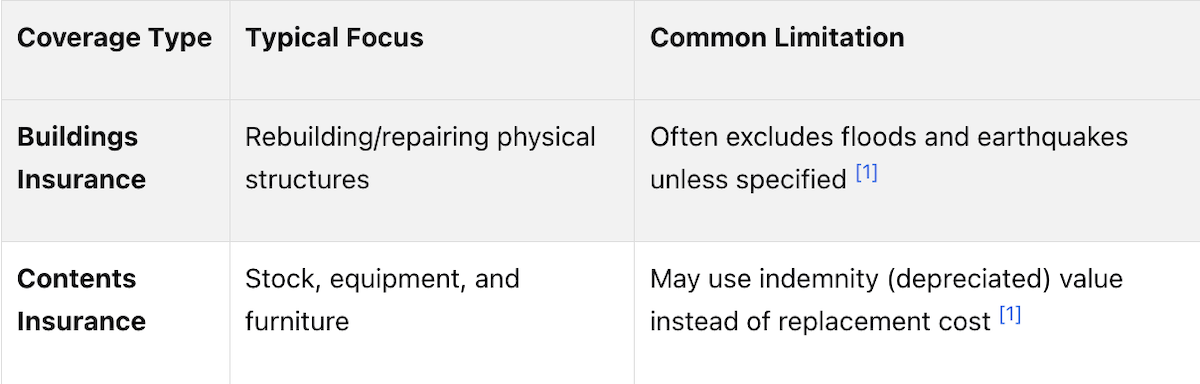
Carefully reviewing exclusions ahead of time is essential. It ensures you understand your coverage fully before needing to file a claim. The next step is to gather all necessary loss-control documents to support your coverage details.
Firearms businesses face unique challenges, from handling expensive inventory to navigating strict regulations and heightened theft risks. Because of this, your insurance policy needs to address these specific demands.
Your policy should include coverage for secure storage and display systems like fireproof safes, vaults, biometric storage units, and glass display cases. Be aware that glass and sign coverage is often an optional addition to standard policies. Without it, you could face steep out-of-pocket expenses if a display case is damaged.
Also, check for equipment breakdown coverage, especially for automated systems like biometric safes and vaults. Eddie Dreyer, a Commercial Lines Staff Underwriter at Central Insurance, highlights the importance of this:
"So much of manufacturing is automated, where computer programming runs the process. That's still equipment, and it's still exposed to failures." [4]
If these systems fail due to mechanical or electrical issues, having coverage can save you from costly repairs. Once your storage systems are protected, make sure your inventory is equally safeguarded.
Your firearms, ammunition, and accessories need their own evaluation to ensure full coverage at the right values. Policies based on actual cash value (ACV) consider depreciation, so a firearm valued at $1,200 today might only yield $800 in a claim due to wear and age.
Additionally, check whether your policy requires endorsements for high-value items or ammunition. Many standard property policies won’t automatically include these without an added rider [8]. If you frequently transport inventory between locations, ask about Inland Marine coverage, which protects your items while in transit - something a standard property policy won’t cover [4].
Firearms insurers often mandate advanced security measures as part of their policies. Failing to meet these requirements could result in denied claims or even policy cancellation. Starting in 2025, many underwriters will require proof of measures like biometric safes or reinforced storefronts as a condition for coverage [7].
"Strong security measures can reduce risks while also lowering insurance premiums." - Joseph Chiarello & Co., Inc. [7]
Here’s a quick look at common insurer requirements for firearms businesses:
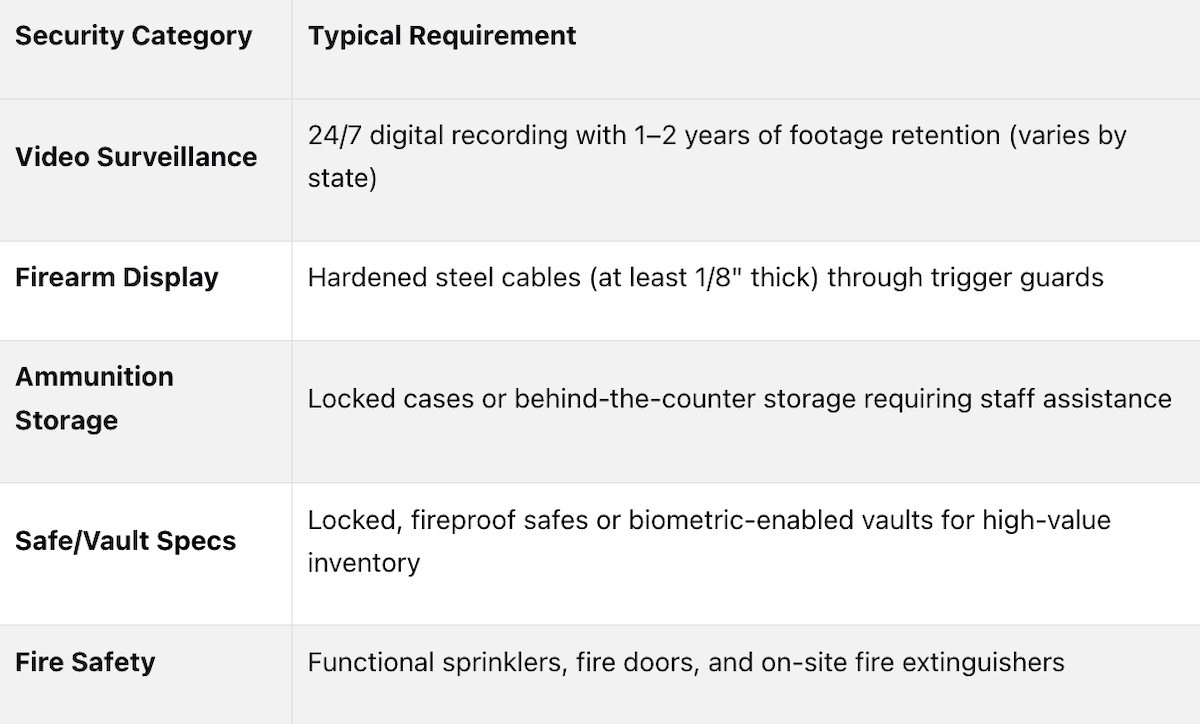
Meeting these standards isn't just about staying compliant - it can also work in your favor. Documenting your security upgrades can give you leverage when negotiating deductibles or sublimits with your insurer. Companies like Joseph Chiarello & Co., Inc. can help assess your current setup to ensure it meets underwriting requirements and identify any gaps before they become costly issues.
Having the right documents on hand is essential for meeting coverage requirements. Insurers use these records to gauge risk, speed up claims, and verify that your business operates responsibly. As Joseph Chiarello & Co., Inc. explains:
"Organized financial and safety records can streamline the underwriting process, ensuring quicker approval for coverage." [2]
Here’s a breakdown of the key documents you need to compile to support your policy coverage.
Start by collecting detailed records about your building's construction materials - whether it’s concrete, structural steel, or wood framing. These details help insurers assess fire risk and calculate premiums accurately.
For security, gather records related to your alarm systems, including testing logs, panic button locations, cellular backup information, and access control data. Surveillance system documentation should confirm camera placement and tamper resistance. Don’t forget to include receipts and installation records for any recent upgrades, such as reinforced storefronts or biometric safes.
Fire protection documentation is crucial for demonstrating your preparedness. This includes both on-site systems and your building's proximity to local fire services. The table below outlines the records you’ll need:
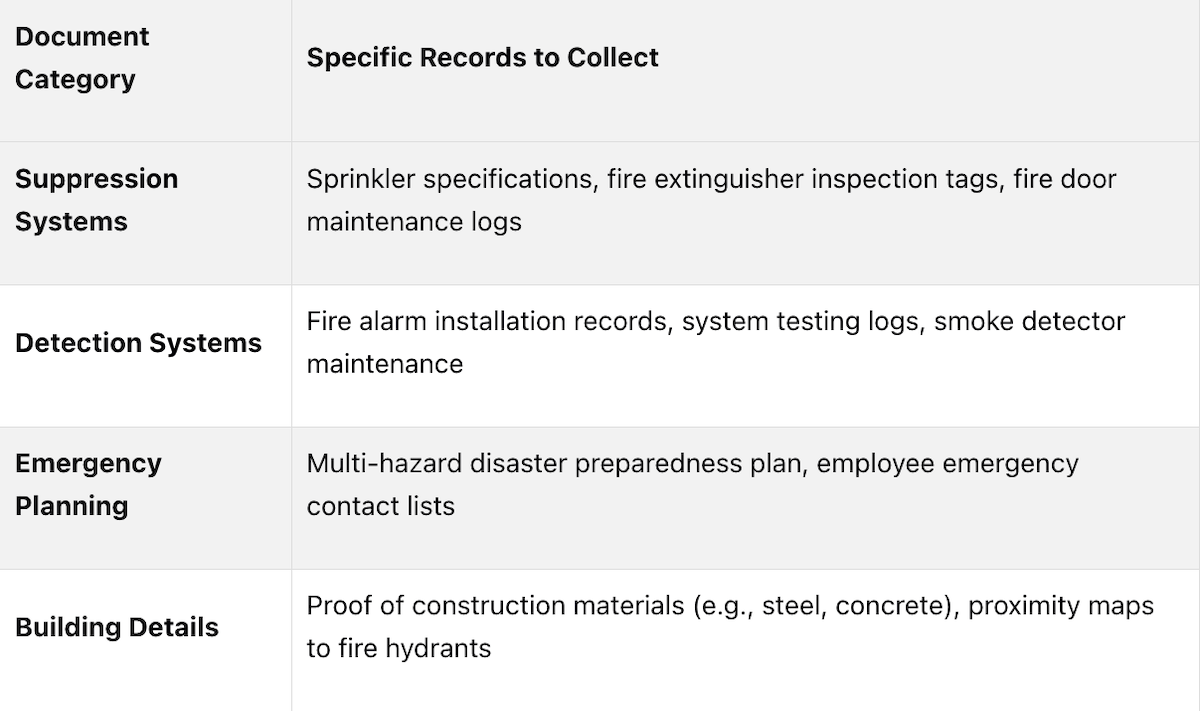
It’s a good idea to store duplicates of these critical records at a separate secure location. Include copies of your insurance policies, supplier contact lists, and computer backups. This precaution ensures you can quickly resume operations if your primary location is compromised [9]. These records not only support your claims but also highlight your commitment to managing risks effectively.
If you’re a Federal Firearms Licensee, staying compliant with regulatory requirements is non-negotiable. Keep your Acquisition and Disposition (A&D) records up to date and reconcile them with at least one annual physical inventory count. Also, ensure ATF Form 4473 is properly filed and accessible. If a loss or theft occurs, report it to the ATF and local law enforcement within 48 hours using ATF Form 3310.11 [9].
Additionally, maintain employee training records that document firearm handling and safety protocols.
"A disaster preparedness plan is a key to safeguarding your business, facilitating a quick recovery, and protecting the public from the potential theft/loss of firearms and ammunition." [9]
Compliance documents do more than fulfill legal obligations - they also serve as critical evidence in liability claims, proving that your business operates responsibly and adheres to industry standards [10]. By keeping detailed and accurate records, you strengthen your overall risk management strategy and enhance your loss-control efforts.
Keeping your insurance policy up to date is essential, especially with rising construction costs that can leave you underinsured if your coverage doesn’t reflect current building values [14]. The steps outlined below can help you address potential gaps before they result in unexpected expenses.
Begin your policy renewal process 60–90 days before the effective date [12]. This gives you enough time to update financial records, review asset lists, and, if necessary, arrange for a professional appraisal. Always insure your property for its full replacement cost - not its market or tax-assessed value.
"A building worth $400,000 on the market can cost $650,000 or more to rebuild to current code with current labor and material costs. Setting limits at market value is one of the most common and costly underinsurance mistakes." - Dragon Insurance [11]
Most policies include a coinsurance clause requiring 80%–90% of the property’s replacement value to be insured. Falling short of this percentage can drastically reduce your claim payout. For example, with an 80% coinsurance clause, if you insure only 60% of the replacement value, a $300,000 claim could be reduced to just $180,000 [11]. To avoid this, consider requesting an Agreed Value Endorsement. This option allows the insurer to agree on the property’s value upfront, effectively suspending the coinsurance clause [11].
Updating your building’s value annually is critical, but it’s not enough. Any changes to the property - like renovations, expansions, or security upgrades - should prompt an immediate policy review. These changes can affect your building’s replacement cost and risk profile, potentially leaving you underinsured if a loss occurs.
The table below highlights common events that should trigger a policy update and the actions you should take:
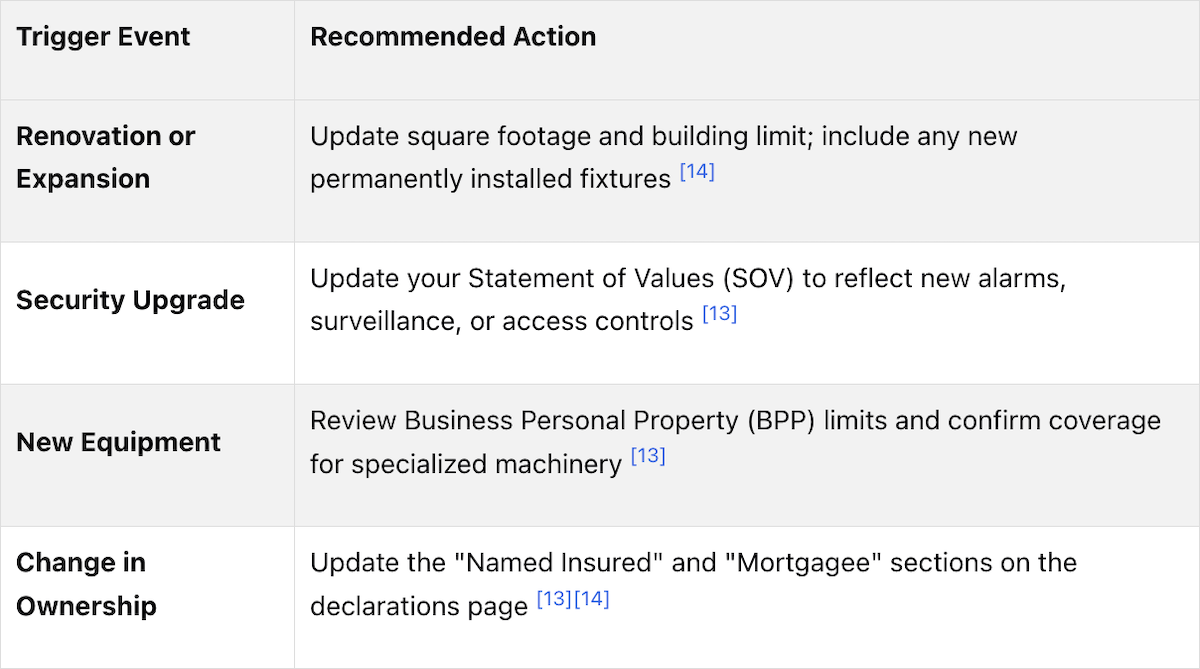
Additionally, ensure your policy includes Ordinance or Law Coverage, especially if your building was constructed before 1990. This type of coverage helps cover the costs of mandatory code upgrades, like ADA compliance or fire suppression systems, that local regulations may require during repairs [14].
As part of your renewal review, confirm that all legal entities are properly listed as named insureds. If your business structure has changed - whether through new partnerships, restructuring, or lease modifications - an outdated declarations page could result in a denied claim. Verify that all mortgagees and property management entities are current as well [13][14].
It’s also important to review your policy endorsements to ensure they align with your operations. Confirm key endorsements such as:
This checklist helps you pinpoint your current coverage and identify potential gaps. By keeping your building data accurate, maintaining proper security documentation, and updating your policy regularly, you can ensure your coverage adapts as your business evolves.
For firearms businesses, the stakes are especially high. The ATF has reported a sharp rise in firearms stolen from Federal Firearms Licensees (FFLs) due to burglaries and robberies over the past decade. On top of that, construction costs across the U.S. have increased significantly in recent years. A building insured just two or three years ago may already be undervalued today. Even small coverage gaps can lead to major out-of-pocket expenses after a significant loss, making proactive planning essential.
Closing these gaps isn’t a one-and-done task. It involves keeping building records current, ensuring your security measures meet insurer requirements, aligning building and inventory limits, and staying mindful of ATF oversight.
That’s where partnering with a specialist can make all the difference. Joseph Chiarello & Co., Inc. has over 40 years of experience in the firearms industry, serving more than 3,000 businesses nationwide [1]. Their tailored programs for Firearms Business and Property Insurance, Commercial General Liability, and Workers' Compensation address the specific risks faced by gun shops, ranges, gunsmiths, and manufacturers. Beyond policies, they offer loss control services, employee background checks, and hands-on claims support - providing expertise that goes far beyond just issuing coverage.
"A first class Insurance Broker representing the insured not the insurance company. They are the very best in the business!" - Fritz S. [1]
Use this checklist as a tool for your annual review and policy renewal discussions with your insurance specialist. It ensures that your building, inventory, and security measures are working together to safeguard your business.
To keep your firearms and ammunition inventory safe, it's crucial to invest in commercial property insurance specifically designed for high-value stock. Standard insurance policies might not provide enough coverage, making specialized protection a must.
To ensure your inventory is properly protected, focus on these key steps: maintain detailed records (including serial numbers and market values), use strong security measures like UL-rated vaults and surveillance systems, and comply with all federal and state storage and licensing regulations.
For tailored solutions, companies like Joseph Chiarello & Co., Inc. offer policies designed to meet these unique requirements.
To make sure you're not underinsured, check that your property limit aligns with the percentage of your building's replacement value specified in your policy’s coinsurance clause. If your coverage falls short of this percentage, your claim payouts could be reduced. It’s a good idea to regularly reevaluate your property’s replacement cost and collaborate with Joseph Chiarello & Co., Inc. to update your coverage. This helps account for factors like business growth, inflation, and shifts in asset values.
Insurers pay close attention to physical security, fire protection, and operational protocols when assessing risks. Typical requirements include UL-rated safes, reinforced doors, burglar-resistant windows, and advanced surveillance systems equipped with alarm backups. For added security, measures like biometric safes and steel mesh barriers might also be necessary.
Fire safety is another critical area. Features such as sprinkler systems, fire alarms, extinguishers, and fire-rated doors are considered essential. Additionally, insurers often emphasize inventory management and access control procedures to further minimize risks.
Don't wait until it's too late to make sure your gun shop is covered. At Joseph Chiarello & Co., Inc., we’re here to help you navigate the ins and outs of gun shop workers compensation insurance to ensure you're prepared for any noise-related risks, including hearing damage. Reach out to us today to review your current policy or get a customized quote. Protect your team and your business with the right coverage—because their safety is worth it.
Call Now: 800-526-2199. Or submit your inquiry below. We look forward to having the opportunity to work with you!