

The short version: ATF eased its federal enforcement stance in April 2026, but your business risk did not drop. If you hold an FFL, I’d treat this as a two-part review right now: check compliance controls and check insurance limits, exclusions, and record-related coverage.
Here’s what matters most:
If I were running an FFL, I would not read these changes as “less risk.” I would read them as different risk. Paperwork mistakes may carry less federal heat, but weak records, stale policy limits, and missing cyber or liability coverage can still cost a lot.
A quick check helps:
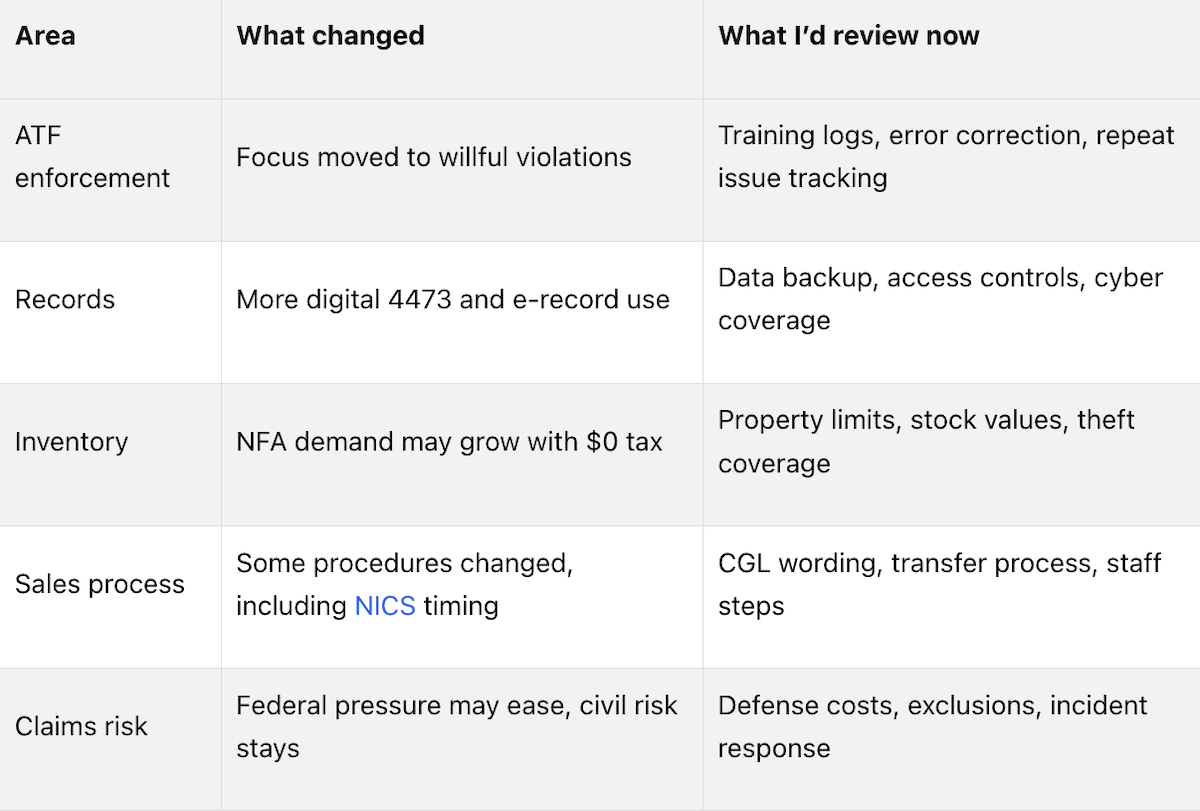
Bottom line: the rulebook changed, so your exposure changed too. I’d review the shop floor, the records system, and the insurance file at the same time.
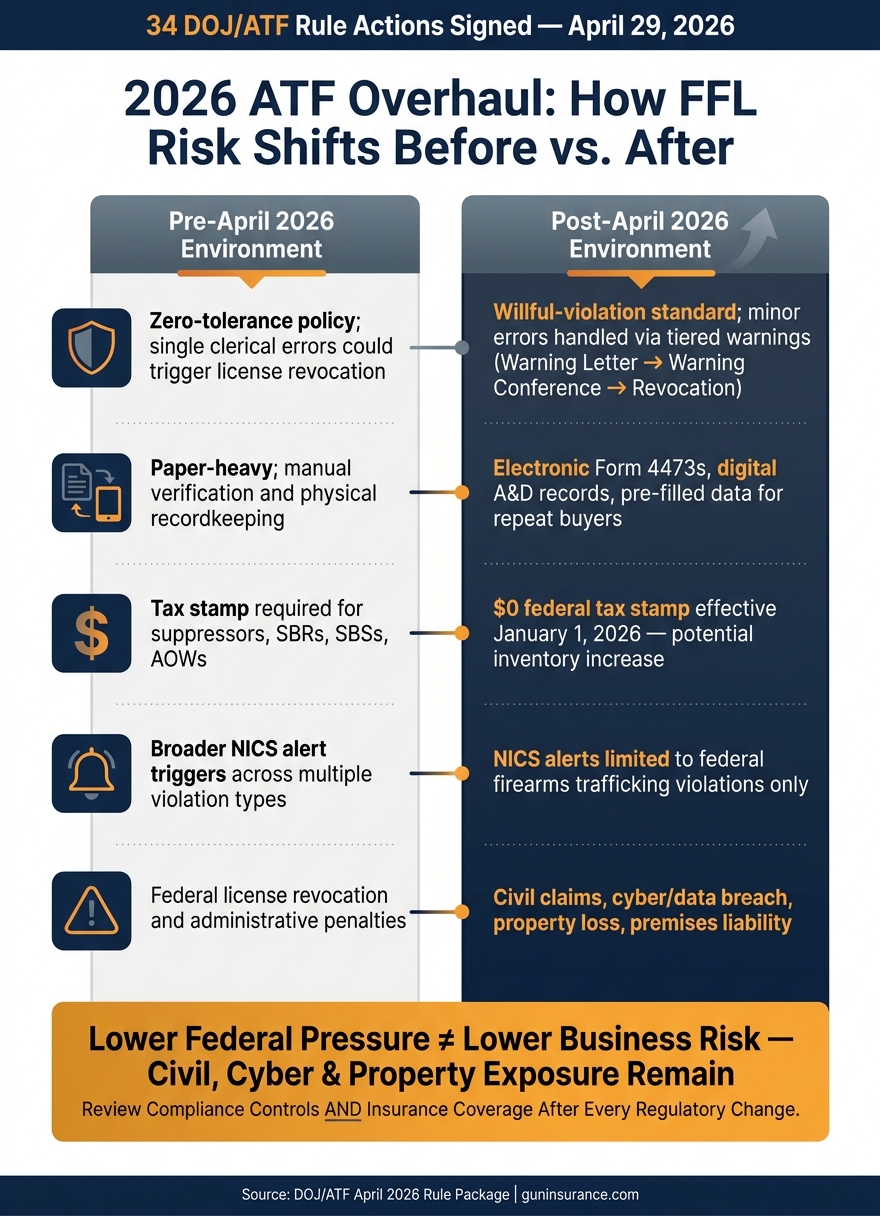
On April 29, 2026, the DOJ and ATF signed 34 rule revisions tied to recordkeeping, background checks, and NFA procedures [7]. The package fell into five buckets: Repeal, Modernize, Reduce Burden, Clarify, and Align. For insurance, the main issue is simple: which of these workflow changes affect documentation, oversight, and loss exposure.
The biggest day-to-day shift is the move from the Enhanced Regulatory Enforcement Policy to the new Administrative Action Policy. Inspections now center on willful violations and traceability, not small paperwork mistakes [1]. The overhaul also permits electronic Form 4473s, electronic records, and pre-filled data for repeat buyers [7]. NICS alerts are now limited to federal firearms trafficking violations only [1].
Here’s where daily workflow starts to change first:
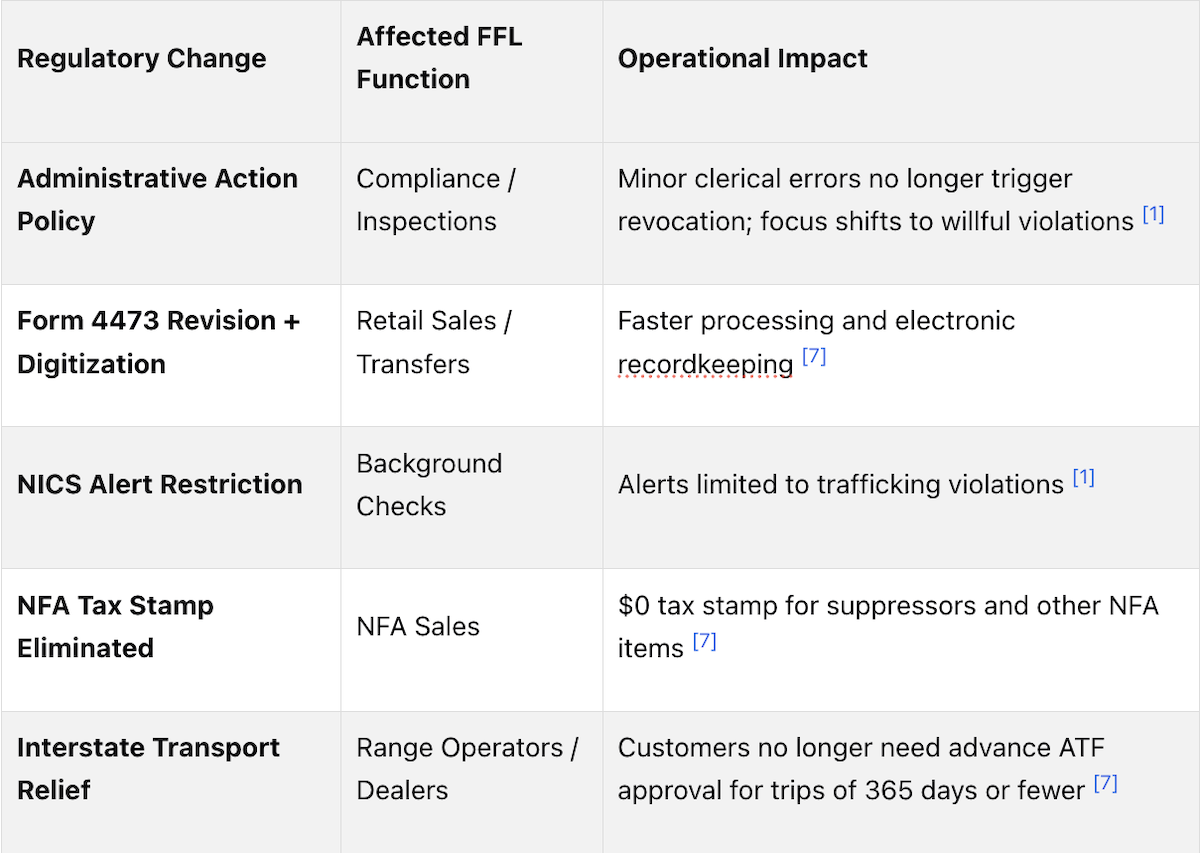
That should make daily work smoother. But less friction doesn't mean less compliance risk. It just changes where the pressure points are.
Retail dealers will notice the Form 4473 and NICS updates first because those steps sit right in the middle of everyday sales. Gunsmiths and NFA makers also get a clear cost break from the new marking adoption rule. If they convert existing GCA firearms into NFA items, they can now use the original manufacturer's serial number and markings instead of engraving their own personal information. That cuts marking costs by an estimated $54 per firearm [6].
Range operators get more room to work as well. Customers heading to out-of-state events with NFA items no longer need to file Form 5320.20 for trips of 365 days or fewer [7]. For businesses that deal with travel-heavy customers, that's one less form slowing things down.
The next issue isn't just what changed in the rulebook. It's how much compliance discipline FFLs still need when the federal stance gets lighter.
April 2026 marks a clear shift: ATF is moving from zero-tolerance enforcement to a willful-violation standard. But that does not mean FFLs can ease up on compliance.
ATF Director Robert Cekada put it this way:
"Our enforcement focus from here on out is on willful violators and criminal actors, not inadvertent compliance issues by responsible owners and licensees." [3]
For FFLs, the key question isn't whether compliance matters less. It doesn't. The question is how this change affects audit exposure, defense costs, and underwriting review.
Lower federal pressure doesn't change the rules you still have to follow every day. Under the new Administrative Action Policy, ATF now uses a tiered response: Warning Letters for minor issues, Warning Conferences for repeat problems, and revocation for willful violations or threats to public safety [4].
That changes the penalty track, not the work itself.
You still need accurate A&D records, timely NICS checks, and complete Form 4473s. The difference is that willful misconduct now brings the sharpest risk. A small mistake may no longer put your license on the chopping block right away, but poor controls, repeat errors, or facts that suggest intent can still create serious trouble.
From an operations standpoint, this isn't about doing less. It's about paying attention to different weak spots.
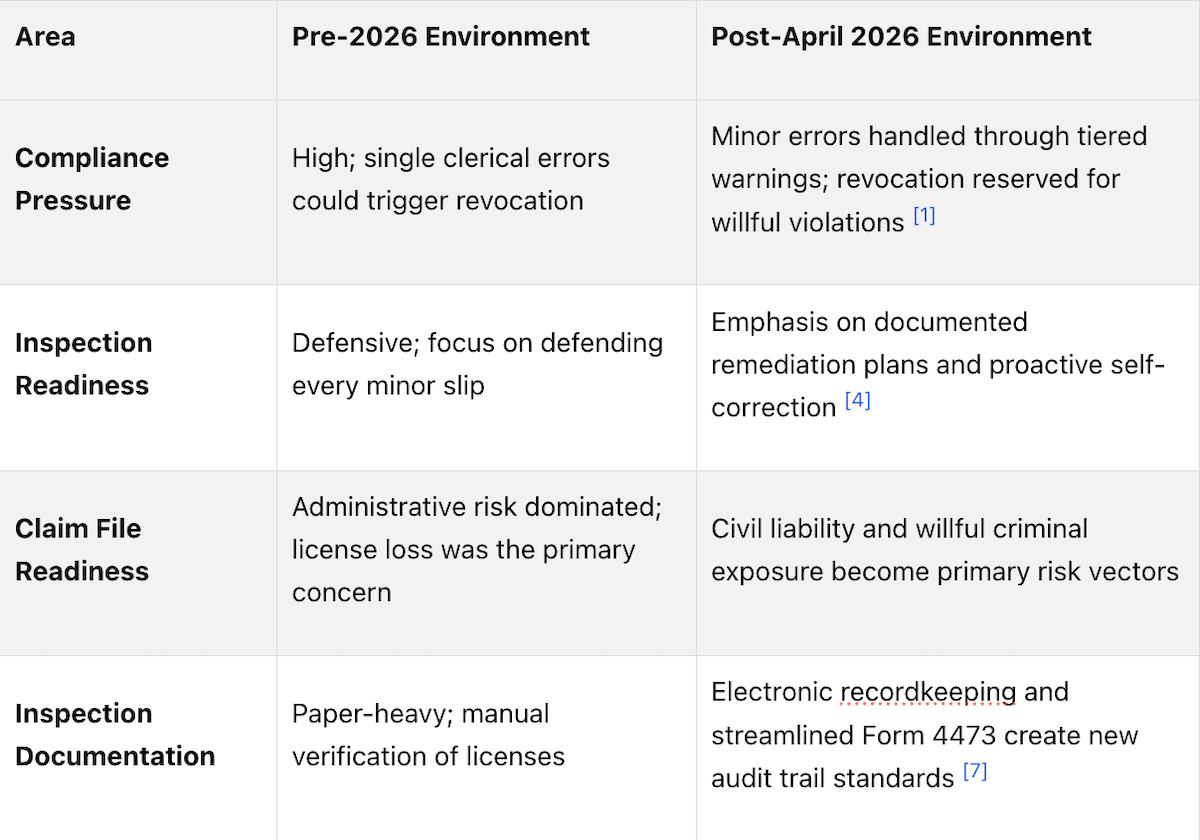
Now is a good time to audit your A&D books and 4473 files. Under the new standards, proactive self-correction is treated as a strong mitigating factor during inspections [4]. That means fixing problems early is no longer just good housekeeping. It can shape how ATF responds.
Written training records matter too. They help show that an error was isolated rather than willful. They also give you proof that can help protect the business after a claim, not just during an inspection. That line matters more now because it can decide whether the outcome is a warning or a revocation, especially when risk starts shifting away from federal enforcement and toward civil claims and insurance review.
A willful-violation standard changes ATF enforcement. It does not change civil exposure. That distinction matters.
When federal revocation pressure eases, civil claims don’t ease with it. The April 2026 overhaul shifts the main risk away from federal license pressure and toward civil claims and insurance gaps.
This is where many businesses get tripped up. When enforcement feels lighter, people relax. Audits get pushed back. Controls get a little looser. Old policy limits stay in place. Coverage sits untouched.
The problem is simple: the exposure doesn’t go away.
A softer ATF posture does not reduce civil exposure or premises liability. If anything, it can make those risks easier to miss because the day-to-day pressure feels lower.
When federal enforcement pulls back, civil exposure fills the gap. Those risks were always there. They just become easier to overlook when ATF attention drops.
The focus shifts back to the losses that keep moving no matter what the enforcement climate looks like:
ATF still treats five willful violations as zero-tolerance. Weak records can hurt during inspections, and they can also cause problems in discovery. The same records often shape discovery, defense, and claims handling.
The quieter risk may be the one that does the most damage: stale policies, old limits, and missing endorsements. Joseph Chiarello & Co., Inc. (guninsurance.com) has spent 40+ years helping FFLs deal with changing regulatory cycles, and periods like this are often when coverage gaps slip by unnoticed. That’s why a coverage review matters now.
When ATF rule changes affect inventory, records, and how sales move through your shop, your insurance has to reflect that new setup.
As federal pressure eases, the main insurance concern starts to move away from license defense and toward property, liability, and cyber risk. Put simply, if enforcement pressure drops, the risk doesn't disappear. It shifts. Now the bigger issues may be property loss, civil claims, and digital data exposure. That makes a policy-by-policy review more important, not less.
The $0 federal tax on suppressors, SBRs, SBSs, and AOWs, effective January 1, 2026, may lead to higher inventory levels for dealers and manufacturers [4]. If your commercial property limits haven't changed, you may be carrying more stock than your policy can cover. And if the overhaul expanded the parts of the premises you use, your property coverage should line up with that footprint.
Commercial general liability also needs a close review if you've started using expanded remote-sale procedures. The 60-day NICS window means each transaction can stay active longer [2]. That may change how risk builds during the sales process.
The shift to standardized electronic recordkeeping and digital 4473s adds another layer. A&D books and Form 4473 files now create cyber exposure. If there's a breach, ransomware attack, or data loss event, the problem doesn't stay in the IT lane. It can turn into a compliance issue and a liability issue fast.
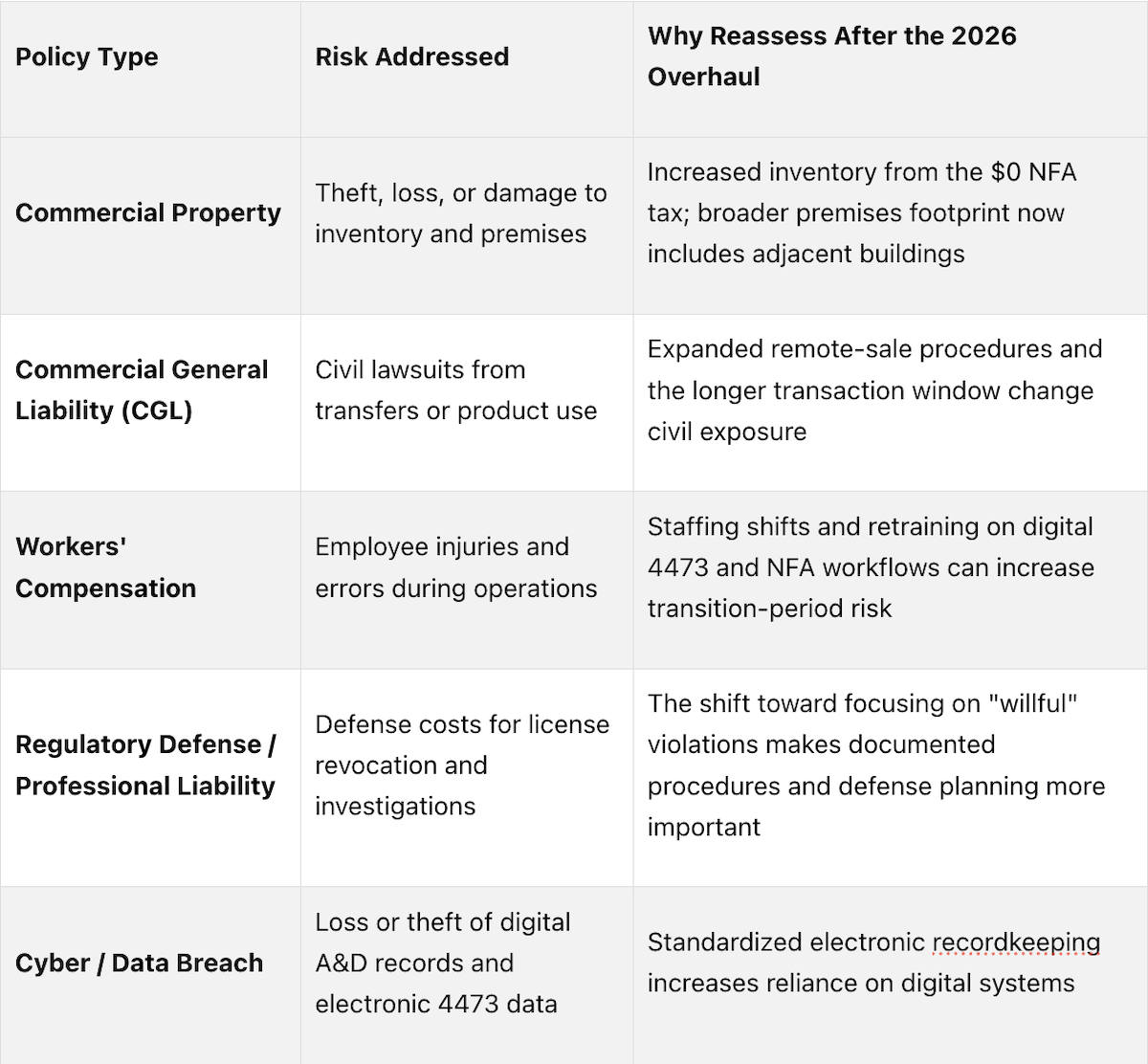
For FFLs, a smart review starts with the parts of the policy where the new exposure is showing up first.
When rules change this much, firearms-specific underwriting experience helps connect workflow changes to the right policy terms and coverage limits. Joseph Chiarello & Co., Inc. (guninsurance.com) has spent more than 40 years working with FFLs in retail, range, gunsmithing, and manufacturing through each regulatory cycle the industry has faced. From there, the job is to match those exposures to the limits, endorsements, and exclusions already in force today.
The April 2026 overhaul brought broad regulatory change. But for FFLs, the big point isn't looser rules. It's shifting risk.
If the rulebook changed, your risk profile changed too.
ATF is now putting its attention on willful violators and criminal actors, not one-off paperwork mistakes. [3] But compliance is only part of the picture. The other part is what those changes mean for liability and insurance coverage.
Lower federal pressure doesn't mean lower business exposure. Civil claims, cyber incidents, property loss, and inventory issues are still on the table no matter what the enforcement climate looks like. On top of that, changes tied to the overhaul, including inventory, records, and premises use, can open coverage gaps if your policy hasn't been updated. [4][5][8][9]
That's why the last step should be a policy review with a firearms-specialist broker.
Treat the 2026 overhaul as two separate reviews:
Joseph Chiarello & Co., Inc. (guninsurance.com) has more than 40 years of continuous experience serving FFLs, gun shops, ranges, gunsmiths, and manufacturers. When operations change, coverage should change with them.
Under the ATF’s current framework, a violation is willful only when the agency can show that a dealer intentionally ignored a known legal duty or showed plain indifference to legal obligations. Put simply, the ATF has to prove intentional conduct and actual knowledge that the conduct was unlawful.
Willful violations that may lead to revocation include:
Not yet. The 2026 reforms make room for electronic records and are meant to update Form 4473, but for now, you should keep using the current version until the new revision is officially final and required.
Public comments on the proposed overhaul stay open through July 7, 2026. When the new form comes out, work with your software provider to make sure your electronic workflow matches the updated rules.
Start with General Liability and Professional Liability. In 2026, even if ATF enforcement becomes less punitive for clerical errors, civil liability exposure does not go away.
Take a close look at whether your coverage lines up with how you handle transactions today. That includes recordkeeping, transfer steps, and the day-to-day use of electronic systems as those practices keep changing.
Don't wait until it's too late to make sure your gun shop is covered. At Joseph Chiarello & Co., Inc., we’re here to help you navigate the ins and outs of gun shop workers compensation insurance to ensure you're prepared for any noise-related risks, including hearing damage. Reach out to us today to review your current policy or get a customized quote. Protect your team and your business with the right coverage—because their safety is worth it.
Call Now: 800-526-2199. Or submit your inquiry below. We look forward to having the opportunity to work with you!