
Employee background checks are a critical step in protecting firearms businesses from theft, legal risks, and operational disruptions. By screening candidates for criminal history, financial instability, and identity verification, businesses can prevent hiring individuals who may pose a threat. This proactive measure not only ensures compliance with federal laws but also safeguards inventory, reduces insurance costs, and minimizes potential losses.
Key takeaways:
Investing in thorough background checks and combining them with robust security policies is essential for firearms businesses to mitigate risks and maintain compliance.

Firearms are highly sought-after, easy to conceal, and maintain their value over time, making them an attractive target for theft. Unlike many retail goods that lose value quickly, stolen firearms are in constant demand and are easily sold on the black market. Online platforms further complicate the issue, enabling employees with ill intentions to anonymously resell stolen inventory, often across state lines or even internationally [5].
Firearms businesses face unique vulnerabilities due to the level of trust placed in their employees. Staff members often have direct access to physical inventory, acquisition and disposition records, and financial transactions. This combination of access and minimal oversight creates a perfect storm for theft risks. When left unchecked, these risks can lead to systematic theft, undermining both the financial and operational stability of the business.
Internal theft in firearms businesses often unfolds gradually, making it difficult to detect. Employees exploit various methods to take advantage of their access and authority.
For example, between September 2021 and November 2023, Kelsey Rutland, an employee at Reeds Family Outdoor Outfitters in Walker, MN, orchestrated a scheme involving fraudulent gift cards. She used these cards to "purchase" 18 firearms and other gear worth $40,700, later reselling the items through her laser engraving business. The scheme was only uncovered when another firearms dealer flagged the fraudulent cards during a transfer attempt. Rutland was sentenced in June 2025 to 2.25 years in prison and ordered to pay nearly $50,000 in restitution [9].
"We are the team in red... It's not just about money, it's about trust." - Andrew Arnold, COO, Reeds Family Outdoor Outfitters [9]
Another common tactic involves collusion with external parties. Employees with the authority to place orders may route payments to fake suppliers or arrange shipments to nonexistent customers. Payroll fraud is another issue, where checks are issued to former employees or entirely fictitious ones. These schemes exploit businesses where a single individual controls too many financial or operational processes [5].
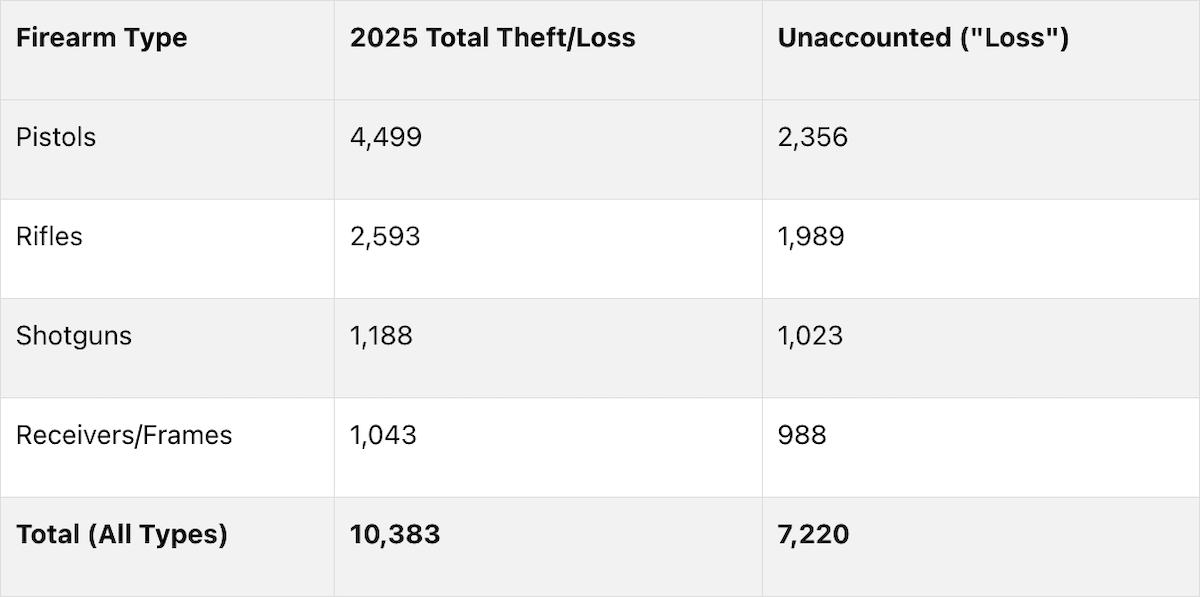
The methods used in these thefts highlight the steep financial and regulatory consequences businesses face. According to the ATF's 2025 FFL Theft/Loss Report, 7,220 firearms were categorized as "Loss" - meaning licensees were unable to account for these firearms during inventory checks. This figure far exceeds the 1,748 firearms reported stolen during burglaries in the same period [6]. Even more concerning, cases of possible employee involvement surged from 74 in 2024 to 466 in 2025, marking a dramatic increase [6].
Beyond the direct cost of lost inventory, firearms businesses face serious regulatory risks. Federal law mandates reporting any theft or loss within 48 hours of discovery [4]. Proposed legislation, such as the Gun Theft Prevention Act, could introduce civil penalties of up to $5,000 per incident for failing to reconcile inventory and report missing firearms [7]. Repeated compliance failures could even jeopardize a business's federal license, a risk that no firearms dealer can afford to take.
Studies show that many missing firearms aren't stolen in break-ins but are lost through internal theft. Background checks are a crucial tool to identify potential risks before they escalate into theft.
Background checks help verify a candidate's identity and reveal any criminal history. They pull data from nationwide criminal databases, including sex offender registries and Department of Corrections records, and conduct single-county searches based on a candidate's 7-year address history. This ensures that local arrest records, which might not show up in national searches, are also reviewed. For example, a prior theft conviction in a nearby county could be missed without this deeper dive [1].
Credit checks provide another layer of insight by highlighting debt and financial instability, which are often linked to theft risk [1][5]. For roles involving high-value inventory or cash handling, this financial screening is especially important. Additionally, identity verification - using Social Security Number (SSN) confirmation and cross-referencing government-issued photo IDs - ensures the records being reviewed belong to the right person [2].
These checks are critical for identifying red flags and ensuring that only reliable individuals are hired for roles involving sensitive access to firearms.
Employee theft in retail can lead to financial losses, but in the firearms industry, the consequences go far beyond lost revenue. Federal law under 18 U.S.C. § 922(g) prohibits individuals with certain criminal histories - such as felony convictions, domestic violence misdemeanors, or active restraining orders - from having access to firearms. Hiring someone who falls into these categories isn’t just a policy violation; it could also lead to serious legal consequences, including felony charges. Background checks are a direct way to screen out prohibited individuals and ensure compliance with federal law, reducing theft risks and strengthening overall security.
It's important to note that "access" goes beyond just handling firearms at the sales counter. Employees involved in inventory management, storage, or record-keeping related to firearm acquisition and disposition are considered to have constructive access to firearms. This makes it essential to conduct background checks on all staff members with significant access and to consider periodic re-screening, such as annual updates, to maintain compliance and security [2].
Incorporating background checks into a broader loss prevention strategy can significantly enhance security. Joseph Chiarello & Co., Inc. (guninsurance.com) offers a tailored background check package for firearms businesses. Starting at just $16.45 per applicant, this service, developed in partnership with IntelliCorp, provides an affordable and effective screening solution [1][2].
Working with a specialized insurer not only ensures your background check program aligns with industry standards but can also positively impact your insurance coverage. A formal screening program signals a lower risk profile to underwriters, which could lead to reduced premiums and better coverage options [2][5]. For a modest cost per applicant, this approach delivers a solid return on investment while reinforcing your theft prevention efforts.
A thorough background check program should examine candidates from multiple angles to provide a well-rounded understanding of who you're bringing on board.
The starting point for any background check is verifying the candidate's identity. This involves reviewing a government-issued photo ID, Social Security card, and conducting an SSN verification to ensure that all records align with the correct individual.
Criminal history checks should be as broad as possible. This includes searches in nationwide criminal databases, sex offender registries, Department of Corrections records, and a detailed 7-year address history. The address history is particularly useful for uncovering local arrest records that broader searches might overlook. For businesses dealing with firearms, these checks are critical to comply with 18 U.S.C. § 922(g), which addresses felony convictions, domestic violence misdemeanors, restraining orders, and unlawful substance use. Hiring someone who falls into these prohibited categories could lead to serious federal penalties.
"It is a business' duty to ensure a potential hire does not have an adverse history that could potentially harm a business or pose a safety risk to employees and clients." - National Shooting Sports Foundation (NSSF) [2]
For roles under a Federal Firearms License (FFL), requiring fingerprint cards and recent photographs is an extra precaution to prevent processing delays.
Beyond criminal checks, confirming work histories and personal references is another critical step in building a complete profile of the candidate.
Verifying a candidate’s previous employment and education helps confirm their qualifications and dependability. When reviewing work history, check job titles, employment dates, responsibilities, and reasons for leaving. Directly contacting past employers or educational institutions - rather than relying solely on what’s listed in an application - can help identify inconsistencies that may signal potential issues [2].
Reference checks offer a deeper look into a candidate’s character and dependability, especially from people who have worked with them directly. For positions involving access to firearms or high-value inventory, this step becomes even more critical.
Some roles demand additional scrutiny. For example, employees handling cash, managing inventory, or transporting firearms should undergo extra layers of screening. Credit checks can highlight financial instability that might pose a theft risk, while driving record reviews are essential for positions involving firearm transportation. Drug testing is also vital in this industry, as federal law (18 U.S.C. § 922(g)) prohibits unlawful users of controlled substances from possessing or handling firearms [2].
Two key policies to consider are implementing a 24-hour reporting requirement - where employees must inform management of any events that could make them a prohibited person - and conducting annual re-screenings. These measures account for the fact that an employee's eligibility can change over time. Experts also suggest keeping all background check records for at least five years to remain audit-ready and compliant with ATF documentation standards [2]. These additional steps not only enhance security but also help minimize risks related to internal theft or other liabilities.
When conducting background checks, firearms businesses must navigate a maze of federal and state rules to ensure compliance and fairness in their hiring processes. Adhering to these guidelines protects both the business and its candidates.
Background checks run through the National Instant Criminal Background Check System (NICS) under the Bipartisan Safer Communities Act (BSCA) are not subject to the Fair Credit Reporting Act (FCRA).
"An employment background check conducted by a licensee [under the NICS voluntary system] shall not be governed by the Fair Credit Reporting Act." - 34 U.S.C. § 40901 [11]
Even though FCRA rules don't apply, NICS-based checks still require written notice and consent from the individual before proceeding [11][12]. If a candidate receives a "Did Not Pass" result, they must be informed of their right to appeal through the Attorney General [11]. Proposed federal guidelines suggest using clear result categories - "Pass", "Pending", and "Did Not Pass" - to avoid confusion with firearm-related checks [12].
Next, let's explore how to handle these checks without crossing ethical or legal boundaries.
How background check results are used is just as important as obtaining them. Automatically rejecting candidates based on any criminal record can create disparate impact liability under Title VII of the Civil Rights Act. This means your policy might unintentionally affect protected groups at a higher rate [15].
The Equal Employment Opportunity Commission (EEOC) emphasizes:
"The fact of an arrest does not establish that criminal conduct has occurred, and an exclusion based on an arrest, in itself, is not job related and consistent with business necessity." - EEOC Enforcement Guidance [15]
Instead of blanket exclusions, assess criminal history using the "Green Factors":
For example, a theft conviction might be a red flag for a role involving firearms inventory management but less relevant for an administrative position. Consistently apply these standards to all candidates, regardless of race, gender, religion, or other protected characteristics [14]. Thoughtful use of background check results can help prevent internal theft and promote a trustworthy workplace environment.
Once you've obtained background check data, safeguarding it becomes critical. These records contain sensitive personal details and must be managed securely. Encrypt electronic records and restrict access to authorized personnel only [16]. Additionally, establish a clear policy for destroying records once the retention period ends.
Some states, like Colorado and Virginia, impose stricter limits on how long background check data can be retained. Following a five-year retention policy aligns with federal firearms offense statutes of limitations and ensures you're prepared for audits [8][13][16]. Be transparent with candidates about how their data will be stored and when it will be destroyed [16].
Integrating background checks into a larger theft prevention strategy strengthens overall security measures. While background checks are a strong initial safeguard, they aren't foolproof. Employees' circumstances can change over time, and internal theft often develops slowly. By combining screening with clear policies, physical safeguards, and expert advice, businesses can create a more comprehensive defense.
A well-drafted anti-theft policy establishes clear expectations for employees and sets the tone for your business operations. For example, requiring employees to report any arrest, conviction, or protection order within 24 hours ensures compliance with federal laws, such as identifying "prohibited persons" who are restricted from handling firearms [2][17]. This approach not only aligns with legal requirements but also fosters a sense of accountability across the workforce.
In addition to written policies, the structure of daily workflows plays a critical role. Implementing a system of separation of duties - where different employees are responsible for tasks like handling deposits, processing payments, and reconciling inventory - helps minimize opportunities for theft. By removing the ability for one individual to manipulate records unnoticed, you create a workplace culture that discourages dishonest behavior. These foundational steps pave the way for additional security measures to protect your business assets.
Background checks provide a snapshot of past behavior, but ongoing monitoring is essential for identifying new risks. Annual re-screenings, for instance, can uncover recent issues like domestic violence charges or substance abuse convictions [2].
Adding external risk assessments to your internal controls further enhances security. Physical safeguards, such as limiting access to firearms storage areas to authorized personnel and maintaining an up-to-date access list, are crucial. These steps significantly reduce exposure to theft. Federal law also mandates that all "responsible persons" - including owners, partners, and policy-making managers - be listed on the Federal Firearms License (FFL) and undergo an ATF background investigation [17]. Keeping documentation standardized ensures you're always prepared for ATF inspections [2].
Specialized insurers do more than just provide coverage - they can help refine your theft prevention strategy. Firearms insurance experts assess your overall risk profile, which can lead to reduced premiums. Businesses that demonstrate a documented screening program are often considered lower risk, making them eligible for better insurance terms [2].
For example, Joseph Chiarello & Co., Inc. offers tailored insurance and risk management services for firearms businesses. Through their partnership with IntelliCorp, they provide access to employee background check packages starting at $16.45 per applicant [2][1]. They also offer loss control services to identify vulnerabilities in firearms retail environments, such as evaluating lock quality and exterior lighting [5].
"Promote a safe work environment by doing a background check for your new hires. We offer a background check package that will reveal the quality of every applicant." - Joseph Chiarello & Co., Inc. [2]
The impact of a well-coordinated strategy is clear. In 2025, the Operation Secure Store (OSS) initiative - a collaboration between the NSSF, ATF, and the firearms industry - achieved remarkable results. Total firearms stolen during FFL burglaries dropped by 60%, from 4,389 in 2024 to 1,748 in 2025. Burglary incidents themselves fell by 43%, from 318 to 181 over the same period [18]. While OSS focuses on physical security, these results highlight the effectiveness of layered, coordinated prevention strategies.
Employee background checks play a crucial role in safeguarding firearms businesses. They help reduce the risk of internal theft and ensure compliance by identifying potential issues before granting employees access to sensitive inventory, customer interactions, or other critical areas. Skipping this step could lead to serious legal and operational challenges. It’s a vital piece of the broader risk management strategies we've covered.
Screening isn't just about theft prevention - it’s also about protecting your Federal Firearms License (FFL). Hiring someone who is legally prohibited from handling firearms isn’t just a mistake; it’s a federal felony under 18 U.S.C. § 922(g). The National Shooting Sports Foundation (NSSF) emphasizes this point clearly:
"If you learn, as a result of running a background check or otherwise, that one of your employees is prohibited from possessing or receiving firearms, you must not allow this prohibited person to receive or possess firearms. Doing so would be a felony." [3]
By combining thorough background checks with other risk management practices - like written anti-theft policies, physical security measures, and regular re-screening - you create a strong, multi-layered defense for your business. No single measure can eliminate every risk, but together, these steps significantly strengthen your operation.
For firearms businesses aiming to build a comprehensive risk management system, Joseph Chiarello & Co., Inc. offers over 40 years of experience in the industry. They provide tailored background check solutions alongside broader strategies to help protect your business [10].
Background checks play a critical role for employees who have direct or constructive access to firearms or ammunition. Direct access refers to physically handling these items, while constructive access involves responsibilities like overseeing inventory or managing security. According to Joseph Chiarello & Co., Inc., conducting these checks both before hiring and periodically during employment helps mitigate risks such as theft, fraud, and compliance violations. This practice not only promotes workplace safety but also ensures adherence to regulations.
The Bureau of Alcohol, Tobacco, Firearms and Explosives (ATF) advises businesses to perform regular background checks on employees - ideally, once a year. This helps ensure compliance with regulations and prevents individuals who are prohibited from handling firearms or ammunition from gaining access. While many companies stick to annual screenings, others may adjust the frequency based on risk evaluations or specific state requirements. It's also wise to conduct extra checks after key events like promotions, transfers to sensitive positions, or when there’s a valid reason to believe a disqualifying incident has occurred.
If a background check identifies a candidate as a prohibited person, federal law bars them from accessing, handling, or transporting firearms or ammunition. In such cases, you should either reassign them to a role that doesn’t involve firearms or, if no such position is available, consider ending their employment. For clarification on disqualifications under 18 U.S.C. 922(g), reach out to your local ATF Area Office. Additionally, make sure any actions taken align with the requirements of the Fair Credit Reporting Act.
Don't wait until it's too late to make sure your gun shop is covered. At Joseph Chiarello & Co., Inc., we’re here to help you navigate the ins and outs of gun shop workers compensation insurance to ensure you're prepared for any noise-related risks, including hearing damage. Reach out to us today to review your current policy or get a customized quote. Protect your team and your business with the right coverage—because their safety is worth it.
Call Now: 800-526-2199. Or submit your inquiry below. We look forward to having the opportunity to work with you!