

Running a firearms business comes with strict regulations, and even small mistakes can lead to losing your Federal Firearms License (FFL). Regular risk audits help you stay compliant, protect your license, and avoid financial or legal troubles. Here's a quick breakdown of the process:
Audits are a proactive way to protect your business and ensure long-term stability.
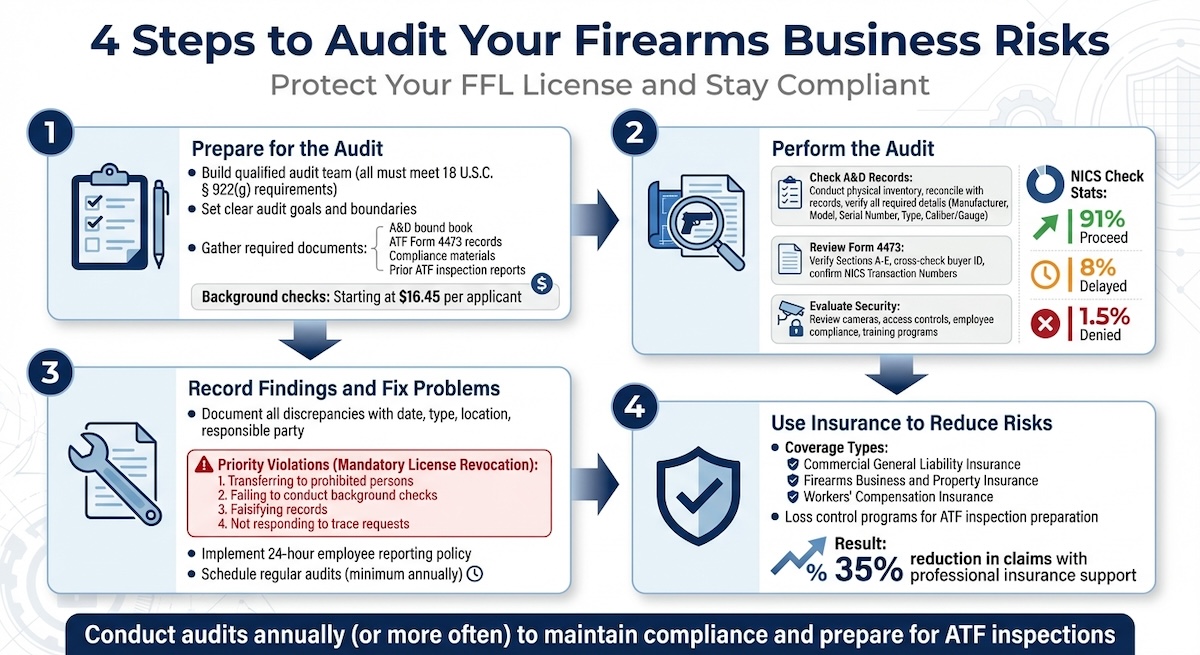
Start by putting together a team that’s knowledgeable in firearms handling and federal compliance. Every team member must meet the eligibility requirements outlined in 18 U.S.C. § 922(g). This means they cannot have felony convictions, domestic violence misdemeanors, restraining orders, or a history of unlawful substance use. These restrictions are non-negotiable. [3]
It’s essential to include the key personnel listed on your Federal Firearms License (FFL), as they are ultimately responsible for your business operations. You’ll also need individuals skilled in conducting physical inventory counts and reviewing complex records such as your Acquisition and Disposition (A&D) bound books and ATF Form 4473s. [1] Additionally, team members who oversee inventory or manage security systems can offer valuable insights since they already have "constructive access" to firearms and understand your internal processes. [3]
To ensure compliance, conduct background checks on your team. Screening packages start at $16.45 per applicant, providing an affordable way to confirm eligibility. [3] This step helps protect your business from potential risks, such as having prohibited individuals handle sensitive documents or firearms during the audit.
Define the scope of your audit to align with ATF inspection practices. Your objectives should include: performing a physical inventory, reviewing A&D records, verifying the accuracy of Form 4473s, and assessing your internal controls and security measures. [1]
Focus on employees with direct access to firearms for the audit. [3] Decide whether you’ll be auditing paper records, digital systems, or both, and ensure your digital processes comply with ATF Ruling 2016-2 and 2022-1. [4] If your business uses off-site storage locations, make sure they’re included in the audit scope alongside your primary premises. [1]
Gather all necessary documentation, starting with your A&D bound book, ATF Form 4473 records, and compliance-related materials. [1] You’ll also need documents that detail ownership information, the responsible persons associated with your FFL, and records of your internal controls and physical security measures. [1]
If you’ve undergone prior ATF inspections, compile the inspection reports and any records of corrective actions you’ve implemented to address past violations. Additionally, prepare a detailed inventory list of all firearms currently in stock to streamline the physical count process. [1]
Keep all these resources at your primary business location, and plan to conduct the audit during regular business hours - mirroring the conditions of an official ATF compliance inspection. [1]
Once you’ve organized your team and materials, you’ll be ready to move forward with the audit.
Start by conducting a thorough physical inventory of all firearms. This means counting everything - firearms on display, in backroom storage, and even those held for gunsmithing or consignment. To keep track, use temporary colored tags to mark each firearm as you go. This system ensures no firearm is counted twice or missed.
Next, reconcile your acquisition and disposition (A&D) records with the physical inventory. Compare the records against the actual stock to uncover discrepancies, such as "ghost" inventory - firearms listed in your records but missing from your stock. These discrepancies could point to unrecorded sales, theft, or administrative mistakes.
Double-check that each firearm’s record includes all required details: Manufacturer/Importer, Model, Serial Number, Type, and Caliber or Gauge. Pay close attention to serial numbers, as characters like '0' and 'O' or '1' and 'I' can be easily confused. Ensure acquisitions are recorded by the end of the next business day and dispositions within seven days of the sale or transfer. If you find errors, correct them by striking through the mistake, entering the correct information with your initials and the date. Avoid using correction fluid or erasers, as these are not compliant.
Once your inventory and A&D records are reconciled, move on to reviewing ATF Form 4473 for further compliance checks.
Carefully examine each section of ATF Form 4473 for accuracy. In Sections A and B, confirm that buyers provide a physical residential address (P.O. Boxes are not allowed) and that all eligibility questions are answered correctly, especially the question about being the "actual transferee/buyer." Section C must include the buyer’s signature and date, while Section D should list accurate firearm details along with the NICS Transaction Number (NTN). Section E requires the FFL employee’s signature and date following verification of the buyer’s ID.
Cross-check the details from the buyer’s government-issued photo ID - such as the ID number, expiration date, and address - against the information in Section A of the form. For firearms that were recently sold, ensure the disposition information in your records (like the buyer’s name, address, and the date of sale) matches what’s recorded on the corresponding Form 4473. Be on the lookout for common errors like blank fields, illegible handwriting, missing NTNs, or inconsistent date formats.
Additionally, verify compliance with multiple sales reporting requirements. If a customer purchased two or more handguns within five consecutive business days, confirm that the sale was reported to the ATF using Form 3310.4. Remember that all completed Form 4473s must be retained indefinitely. Also, keep in mind that about 91% of NICS checks result in an immediate "Proceed", roughly 8% are delayed, and only 1.5% result in a denial [5].
An effective audit goes beyond recordkeeping - it also involves assessing your physical security and employee compliance. Start by reviewing your security measures, such as surveillance cameras, well-lit parking lots and entryways, and access control systems.
Check that your internal controls are up-to-date. Verify that ownership records and the designated "responsible person" information are current. Additionally, ensure that all employees with direct or indirect access to firearms (including those managing inventory or security systems) are not prohibited persons under 18 U.S.C. § 922(g). Keep background check documentation, including consent forms and screening results, for at least five years.
Evaluate your employee training programs to ensure staff are well-versed in federal regulations, situational awareness, de-escalation techniques, and active shooter protocols like "Run-Hide-Fight."
If you use electronic record-keeping systems, confirm that these systems offer encrypted cloud storage, tamper-evident audit trails, and reliable access during business hours. These features help maintain compliance and safeguard your records.
After completing the audit, make sure to document every issue before moving forward with fixes. Use a consistent system to log details like the date, type of issue, its location, and the party responsible. For instance, if your Acquisition & Disposition records are missing three serial numbers, note exactly which entries are affected and when the errors likely happened. Keep track of follow-up actions and assign responsibility for each correction. To protect sensitive information and remain compliant with the Fair Credit Reporting Act (FCRA), store digital logs in encrypted files and secure physical documents in locked cabinets with access logs.
Start by fixing the most critical violations, especially those that could result in losing your license, then address less urgent issues. Refer back to the discrepancies flagged during your audit to prioritize corrective actions. The ATF highlights four violations that can lead to mandatory license revocation: transferring firearms to prohibited individuals, failing to conduct background checks, falsifying records, and not responding to trace requests [1]. Tackle these immediately.
For employee-related concerns, establish a 24-hour reporting policy requiring staff to inform management if they become a prohibited person - such as after a domestic violence charge or restraining order. If an employee is no longer eligible to handle firearms, reassign them to a different role or, if necessary, terminate their employment. Be sure to document every violation and the steps taken to address it, as these records may be reviewed during inspections. While federal law doesn’t require background checks for Federal Firearms Licensees, the ATF strongly recommends them. In some states, like Colorado, periodic background checks are mandatory [3]. Once issues are resolved, strengthen your compliance by scheduling regular audits.
Plan at least one thorough audit each year to review physical inventory, bound book records, and Form 4473 compliance. Create a recurring audit calendar to ensure you're ready for ATF inspections, which often occur without notice during business hours [1]. Regular audits not only help you catch and fix recurring violations but also demonstrate that you're taking compliance seriously - something the ATF considers when evaluating potential license revocation for repeated issues [1]. During these audits, check compliance with federal laws under the GCA and NFA, as well as state and local regulations. Update your screening and risk management policies annually to reflect any legal changes, and document all corrective actions to show your dedication to maintaining compliance [1].
Once you've identified vulnerabilities during your audit, insurance becomes your financial safety net. It helps protect against theft, range accidents, and compliance-related issues, ensuring your business is better prepared for unforeseen challenges [2]. Matching your insurance coverage to the risks uncovered in your audit is key. Coverage typically includes property damage and legal costs, shielding you from criminal and civil liabilities. Additionally, insurance professionals can guide you through claims processes and manage communications with auditors and adjusters [6].
Even in situations where no formal charges are filed, firearm-related incidents may still lead to both criminal and civil proceedings. Proactively addressing these risks with the right insurance coverage not only safeguards your finances but also helps maintain your business's reputation and stability [2].
Here are the primary types of insurance policies tailored for firearms businesses:
Each of these policies addresses specific risks identified during your audit. It's crucial to collaborate with an experienced firearms insurance agent who understands industry-specific challenges, such as range accidents and regulatory compliance. Maintaining detailed records of your inventory, transactions, and customer data not only supports compliance efforts but also simplifies the claims process in the event of a loss [2].
Beyond standard coverage, loss control insurance focuses on addressing risks unique to your business and its location [7]. For example, Joseph Chiarello & Co., Inc. offers loss control programs designed to assess operational risks and prepare businesses for ATF inspections and internal audits [7]. These programs often include measures like employee background checks, which help enhance workplace safety and reduce risks from new hires [7].
"Identify the risks and exposures your business may face with the help of Joseph Chiarello & Co., Inc.'s loss control insurance program." - Joseph Chiarello & Co., Inc. [7]
Insurance underwriting services play a critical role in ensuring your coverage limits align with the actual inventory and liability risks revealed during your audit [7]. Regular consultations with insurance experts can help identify and close any coverage gaps, reducing your exposure to liabilities that general policies might not address [6]. Additionally, following insurance risk management guidelines allows you to establish strict equipment maintenance schedules and implement secure storage procedures for firearms and ammunition [2].
Running a successful firearms business audit starts with careful preparation. This means putting together a skilled team, setting clear goals, and gathering all necessary documents. Laying this groundwork early helps identify risks and avoid costly mistakes that could lead to fines or even license suspension [9][11]. During the audit itself, it’s crucial to review acquisition and disposition records, inspect ATF Form 4473 for compliance issues, and evaluate security measures. Since non-compliance with ATF regulations can result in business suspension, these steps are not just important - they’re essential [10][12].
When discrepancies are found, document them thoroughly and take corrective action right away. Businesses that conduct annual audits significantly reduce the chances of violations and financial penalties [8][11]. For even stronger compliance, consider implementing a quarterly audit schedule to maintain accountability and stay ahead of potential issues.
Improving your audit process does more than ensure compliance - it also strengthens your position when working with insurance providers. By collaborating with specialists in firearms industry insurance, you can extend your risk management strategy well beyond internal audits. Joseph Chiarello & Co., Inc., for example, offers customized solutions such as Workers' Compensation, Firearms Business and Property Insurance, and Commercial General Liability Insurance to address the unique challenges faced by firearms businesses. Their services also include employee background checks, loss control consulting, and expert claims assistance [3].
One firearms retailer saw a 35% reduction in claims after incorporating professional insurance support into their audit routine [12][13]. As Fritz S., a satisfied client, shared:
"A first class Insurance Broker representing the insured not the insurance company. They are the very best in the business!" [3]
Expert insurance guidance not only helps you navigate complex federal regulations but also ensures your coverage aligns with the risks identified during audits. This partnership can be a game-changer for safeguarding your business.
There’s no federal mandate dictating how frequently internal audits for FFLs (Federal Firearms Licenses) need to happen. Despite this, many firearms businesses opt for annual or biannual audits. Why? These regular reviews help ensure compliance with regulations and keep them ready for ATF inspections. By identifying potential risks early, businesses can stay on top of requirements, which is why yearly audits have become a widely accepted practice.
One of the most frequent issues during ATF audits stems from record-keeping and documentation errors. This can include failing to log firearm transactions correctly, making improper corrections in bound books, or neglecting to maintain accurate transfer records.
Another common problem lies with ATF Form 4473. Incomplete or incorrect information on these forms often leads to compliance headaches.
To steer clear of these pitfalls, focus on accurate record-keeping and ensure you're following ATF regulations closely during audits. Attention to detail can make all the difference.
If your audit reveals a missing or unaccounted-for firearm, the first thing you need to do is report the loss or theft to law enforcement within 48 hours. This is a federal requirement and helps ensure you're meeting legal obligations while addressing the risks tied to unaccounted firearms.
Don't wait until it's too late to make sure your gun shop is covered. At Joseph Chiarello & Co., Inc., we’re here to help you navigate the ins and outs of gun shop workers compensation insurance to ensure you're prepared for any noise-related risks, including hearing damage. Reach out to us today to review your current policy or get a customized quote. Protect your team and your business with the right coverage—because their safety is worth it.
Call Now: 800-526-2199. Or submit your inquiry below. We look forward to having the opportunity to work with you!