

Transporting and shipping firearms are governed by distinct legal rules in the U.S., and understanding these differences is essential to avoid legal trouble. Here's the key takeaway:
Each method comes with its own set of requirements, costs, and risks. Transporting allows personal control but requires adherence to state and federal laws. Shipping is faster for long distances but involves higher costs and carrier-specific restrictions.
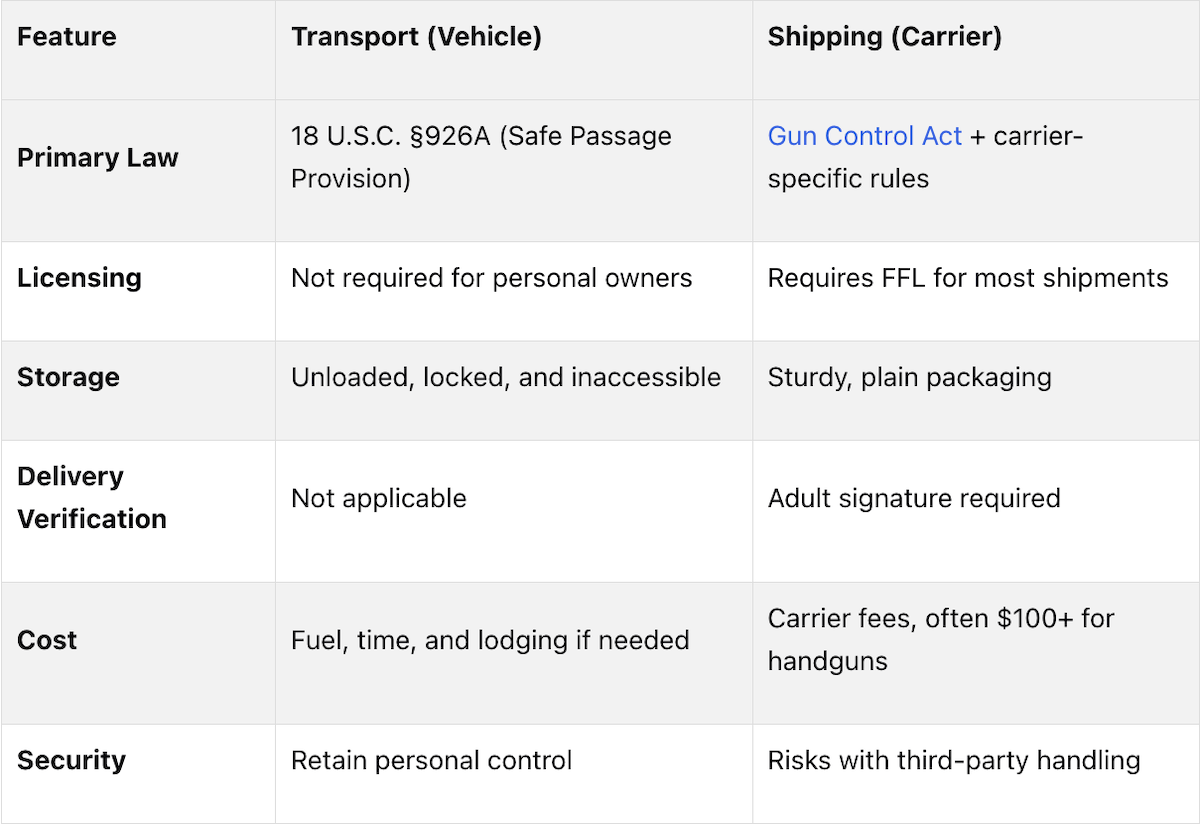
For businesses or individuals, compliance with these rules is non-negotiable to avoid legal and financial risks.
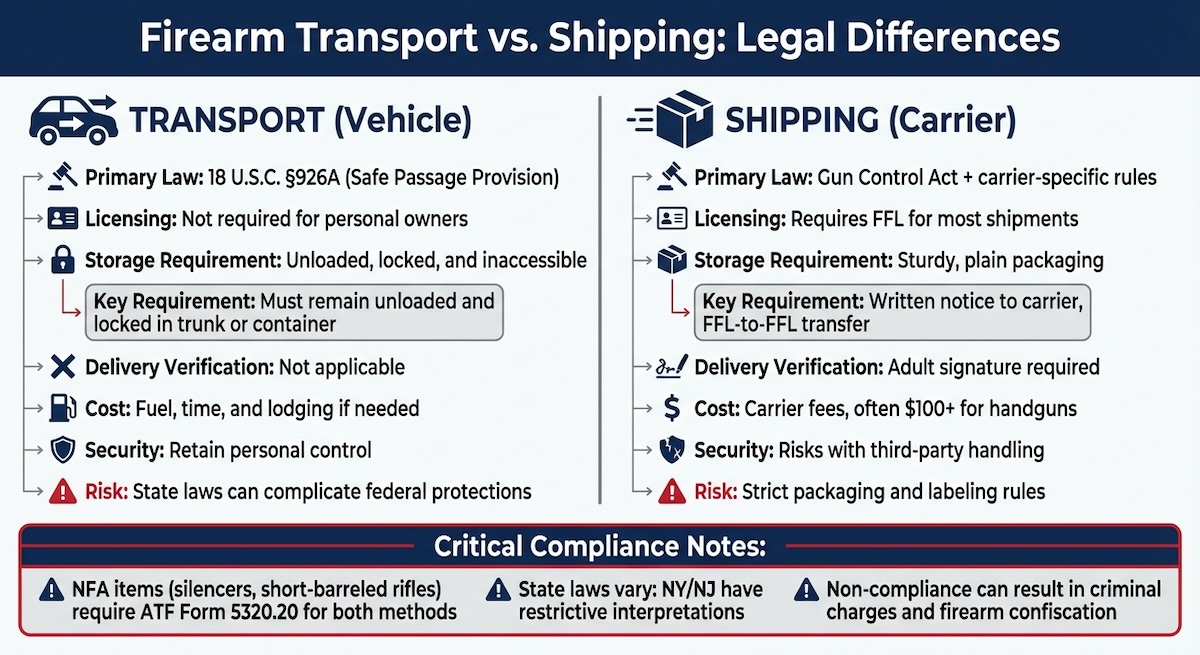
The Firearm Owners Protection Act (FOPA), outlined in 18 U.S.C. § 926A, ensures lawful interstate transport of firearms under specific conditions. According to the law:
"Notwithstanding any other provision of any law... any person who is not otherwise prohibited... shall be entitled to transport a firearm for any lawful purpose from any place where he may lawfully possess and carry such firearm to any other place where he may lawfully possess and carry such firearm if, during such transportation the firearm is unloaded, and neither the firearm nor any ammunition being transported is readily accessible." [3]
This protection hinges on strict compliance with its rules. Firearms must be unloaded and stored in a way that makes them inaccessible. For vehicles with a trunk, the firearm should be locked securely inside. If the vehicle lacks a separate trunk - like in SUVs or hatchbacks - the firearm must be placed in a locked container. Glove compartments or center consoles do not meet the standard [3][2].
Transporting items regulated under the National Firearms Act (NFA) adds another layer of complexity. These items require prior approval using ATF Form 5320.20 before crossing state lines [4]. Additionally, individuals such as convicted felons, fugitives, illegal drug users, or those under domestic violence restraining orders are prohibited from transporting firearms across state lines [8].
Although FOPA provides "safe passage" protections for firearm transport, state laws can complicate the process. Federal law aims to override state restrictions during transit, but court rulings - especially in northeastern states - have significantly limited these protections [8].
For instance, travelers in New York and New Jersey have faced criminal charges for deviations from continuous travel, such as extended stops, flight delays requiring overnight stays, or declaring firearms at airports in restrictive states. These scenarios can nullify federal protections under FOPA [7].
To stay within federal guidelines, avoid unnecessary stops in restrictive states like New York or New Jersey. Ensure the journey remains strictly interstate, traveling directly from a lawful starting point to an equally lawful destination [4][7].
Some states impose additional rules for new residents. For example:
Carrying proper documentation can help prevent legal issues during transport. It's wise to keep:
These documents are especially important for businesses to maintain compliance during inspections.
For air travel, the Transportation Security Administration (TSA) has its own rules. Firearms must be unloaded and stored in a hard-sided, locked container. According to the TSA:
"The container must completely secure the firearm from being accessed. Locked cases that can be easily opened are not permitted." [5]
Firearms must be transported as checked baggage and declared at the ticket counter. Failing to declare them is a criminal offense [4][5].
If using commercial carriers like moving companies, note that most carriers cannot legally transport firearms without proper federal licensing [4]. As a result, many businesses must handle firearm transport themselves.
While federal law does not always require ammunition to be stored separately, it's a good practice to keep it in a locked container separate from the firearm. This ensures both remain inaccessible during transport [4][6].
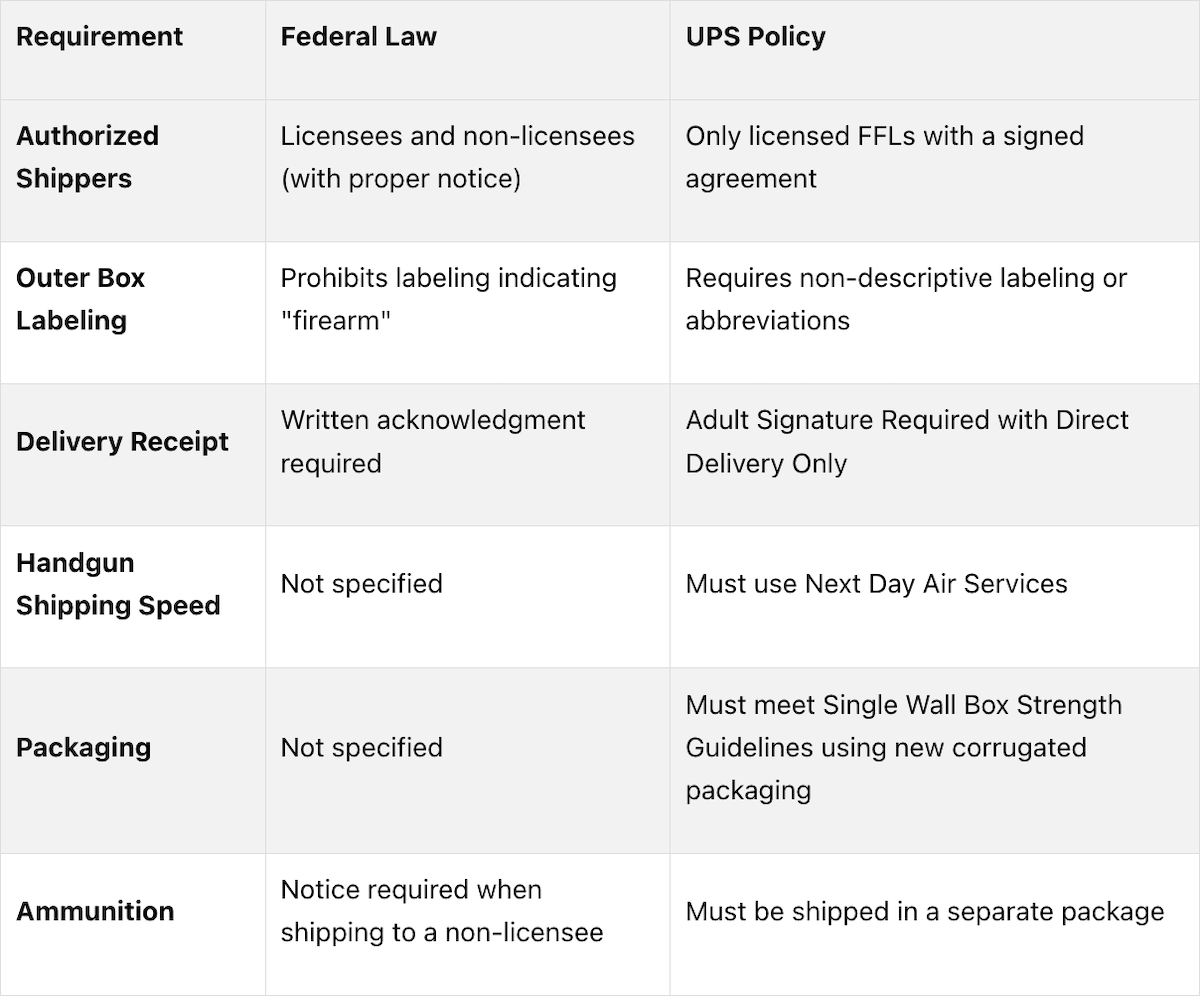
Per 27 CFR §478.31, shippers sending firearms or ammunition to non-licensees via common or contract carriers must provide written notice [10]. However, federal law prohibits carriers from placing any labels or markings on the package that indicate it contains a firearm [10].
USPS regulations treat firearms differently based on their type. For example, handguns are generally not allowed to be mailed unless they are being shipped between licensed manufacturers, dealers, or importers, or for use by authorized government or law enforcement agencies [9]. On the other hand, unloaded rifles and shotguns can be mailed as long as the sender complies with all applicable federal, state, and local laws. When shipping firearms across state lines to private individuals, an FFL (Federal Firearms Licensee) is usually required to facilitate the transfer. However, individuals may mail a rifle or shotgun to themselves for lawful purposes, such as hunting [9].
Federal law also requires carriers to obtain a written acknowledgment of receipt when delivering firearms in interstate or foreign commerce [10]. USPS regulations mandate that regulated firearms be shipped using a service with tracking and signature capture unless the shipment is between licensed dealers, manufacturers, or importers. Additionally, licensed entities shipping handguns must file PS Form 1508, Statement by Shipper of Firearms, with the postmaster [9].
These rules are further clarified by individual carrier policies, which are outlined below.
UPS has stricter policies than federal law when it comes to firearm shipments. It only accepts shipments from licensed FFLs (Federal Firearms Licensees) [11]. While federal law permits non-licensees to ship firearms under certain conditions, UPS requires shippers to hold a valid FFL. Additionally, UPS mandates that no information on the outer packaging identifies the contents as firearm-related [11].
UPS also enforces specific delivery and packaging protocols. Firearms must be handed directly to UPS through scheduled pickups or designated UPS Customer Centers - not through third-party retailers or UPS Access Point locations [11]. Furthermore, UPS does not accept automatic weapons, firearms without serial numbers, or parts that can be assembled into a complete firearm [11].
Securing comprehensive insurance is critical when shipping firearms. UPS provides information about declared value and liability for firearm shipments in its tariff documents and service guides [1]. USPS allows indemnity claims if a firearm is lost or if repair costs exceed the declared value, as verified by a reputable dealer [9].
For businesses shipping firearms regularly, having specialized insurance is vital. Companies like Joseph Chiarello & Co., Inc. offer Firearms Business and Property Insurance, which is tailored to protect against losses, damage, or theft during shipping. This type of coverage goes beyond standard carrier liability, addressing the specific risks firearms businesses face when transporting inventory across state lines or delivering products nationwide.
When it comes to firearms, the legal requirements for transporting versus shipping them are distinct, particularly in terms of licensing, documentation, and approved methods.
Under the Safe Passage Provision, transporting firearms requires that they remain unloaded and locked in a container that’s not easily accessible from the passenger compartment. Shipping, however, operates under a different set of rules. According to 18 U.S.C. §922, only licensed manufacturers, dealers, or importers can ship firearms across state lines. Private carriers, such as UPS, add further restrictions by only accepting firearm shipments from licensed Federal Firearms Licensees (FFLs) under specific agreements. If your business lacks an FFL, you’re unable to ship firearms through these carriers.
Documentation requirements also differ significantly. Personal transport doesn’t require federal documentation, though it’s wise to inform law enforcement if you’re stopped. On the other hand, shipping firearms requires notifying the carrier in writing that the package contains a firearm. The carrier must then obtain a written acknowledgment upon delivery. For items regulated under the National Firearms Act (NFA), such as silencers or short-barreled rifles, both transport and shipping require filing ATF Form 5320.20 and securing approval before crossing state lines.

Now, let’s look at how cost, timing, and security differ between these two methods.
The costs associated with transporting versus shipping firearms vary widely. For personal transport, expenses include fuel, time, and possibly overnight stays for long trips. Shipping, however, involves service fees that can add up quickly. For example, carriers often require handguns to be shipped via Next Day Air, which can cost $100 or more depending on the package’s weight and destination. Long guns may qualify for less expensive ground shipping, but businesses also need to budget for packaging materials that meet strength and labeling requirements.
Timing is another key factor. Shipping is typically faster for long-distance moves - Next Day Air can deliver within 24 hours. For local or regional moves, personal transport offers more flexibility since you control the schedule and route. However, shipping timelines can be affected by the receiving FFL’s availability, as they must be present during business hours to accept the delivery.
Security concerns also play a major role. When transporting firearms yourself, you retain custody, which minimizes the risks of third-party handling. However, you must follow the laws of every state along your route. The Safe Passage Provision doesn’t protect you if you make extended stops or significantly deviate from your route. There have been cases where travelers faced legal trouble in states with restrictive firearm laws, even when they attempted to comply with federal regulations.
Shipping introduces its own risks. Federal law prohibits carriers from marking packages to indicate they contain firearms, reducing the chances of theft during transit. Carriers also require adult signatures and direct delivery to prevent packages from being left unattended. Still, once a firearm enters the carrier’s system, the shipper loses direct control over it.
Managing liability is another area where transport and shipping differ significantly.
For businesses using company vehicles, it’s crucial to ensure firearms are unloaded and stored in a way that complies with the "readily accessible" rule. Firearms should be locked in the trunk or, if no trunk is available, in a locked container out of immediate reach. Failing to meet these requirements can result in criminal liability, particularly in states with stricter regulations.
Shipping comes with its own set of liabilities. Federal law imposes severe penalties for shipping firearms to prohibited individuals, such as those with certain criminal convictions or under specific court orders. To avoid issues, verify the recipient’s FFL credentials. Private carriers like UPS only accept shipments through contractual agreements, and shipments without proper documentation or authorization risk being seized or denied.
Insurance is another critical consideration. Standard commercial auto policies may not cover firearms during transport, and typical homeowner’s or renter’s insurance often caps firearm coverage at $2,500 to $5,000 - amounts that may fall short for businesses with larger inventories. Specialized insurance options, like those offered by Joseph Chiarello & Co., Inc., can provide coverage for losses, damage, or theft during both transport and shipping.
To minimize risks, businesses should tailor strategies to their operations. For transport, this might include written policies instructing drivers to limit stops in states with restrictive laws and adhere to proper storage practices. For shipping, ensure compliance by verifying FFL credentials, using approved packaging materials, and shipping ammunition separately from firearms. Comprehensive insurance coverage is essential to protect against unexpected events during transit.
Transporting firearms under the Safe Passage Provision (18 U.S.C. §926A) is legally distinct from shipping firearms, which involves more stringent requirements. Personal transport allows individuals to move firearms between locations where possession is legal, provided they are unloaded and stored out of reach. Shipping, on the other hand, requires a Federal Firearms License (FFL), adherence to carrier-specific rules, proper packaging, and notification protocols.
Failing to comply with these regulations can result in serious consequences, including criminal charges, civil penalties, loss of licenses, and firearm confiscation. Businesses must take extra precautions, such as verifying recipient FFL credentials, using compliant packaging and labeling, keeping accurate records, and ensuring secure handling throughout the shipping process.
The complexity of these regulations highlights the importance of managing risks effectively. Federal protections like those under the Firearm Owners Protection Act (FOPA) often serve as "affirmative defenses", meaning legal challenges may still arise before these protections can be applied. Even when federal laws are followed, travelers have faced arrests in areas with stricter local firearm regulations.
To address these challenges, firearms businesses should consider specialized insurance coverage. Providers like Joseph Chiarello & Co., Inc. offer tailored solutions to help protect against regulatory and operational risks, reducing the likelihood of financial setbacks or disruptions caused by compliance issues.
If you're traveling with a firearm, the Firearm Owners Protection Act (FOPA) offers legal protection even if you make an overnight stop. However, this protection applies only if the firearm is unloaded and neither the firearm nor its ammunition is easily accessible or within reach from the passenger compartment during transport. Make sure you follow these guidelines to stay within the law's protections.
If you need to ship a firearm, you can do so using a common or contract carrier, either to a resident within your state or to a licensed dealer (FFL) in any state. Federal law requires you to inform the carrier that the package contains a firearm, but it specifically prohibits marking the package to indicate its contents. For handguns, you'll need to use a carrier, as they can't be sent through the regular mail. Additionally, an FFL is generally required if you're shipping firearms commercially or engaging in firearm sales as a business.
Firearms businesses need insurance designed specifically to cover firearms during transit. Firearms business and property insurance provides protection against risks tied to transporting firearms, offering coverage for potential losses or damages that may occur along the way.
Don't wait until it's too late to make sure your gun shop is covered. At Joseph Chiarello & Co., Inc., we’re here to help you navigate the ins and outs of gun shop workers compensation insurance to ensure you're prepared for any noise-related risks, including hearing damage. Reach out to us today to review your current policy or get a customized quote. Protect your team and your business with the right coverage—because their safety is worth it.
Call Now: 800-526-2199. Or submit your inquiry below. We look forward to having the opportunity to work with you!