

What is firearms transport liability insurance?
It’s specialized coverage that protects firearms, parts, and ammo from theft, damage, and liability during shipping.
Do I need an FFL to legally ship firearms?
Yes. Interstate firearm transport requires a valid Federal Firearms License.
What risks does firearms transport insurance cover?
Theft, loss, damage in transit, and third‑party injury or property claims.
What can void my transport insurance coverage?
Improper storage, failing to notify the carrier, or violating federal transport rules.
Why choose agreed‑value coverage for firearms in transit?
It guarantees full pre‑set reimbursement without depreciation disputes after a loss.
How do I pick the right firearms transport insurance policy?
Work with firearms‑industry specialists, confirm inland transit and liability coverage, and review your policy annually.
•••••
This insurance is essential for firearms businesses to manage risks, comply with regulations, and avoid costly liabilities.

The Gun Control Act (18 U.S.C. Chapter 44) sets the rules for interstate and international firearms and ammunition commerce [6][8]. If your business involves shipping firearms, having a valid Federal Firearms License (FFL) is non-negotiable. As outlined in 18 U.S.C. § 922(a)(1)(A):
"It shall be unlawful for any person except a licensed importer, licensed manufacturer, or licensed dealer, to engage in the business of importing, manufacturing, or dealing in firearms, or in the course of such business to ship, transport, or receive any firearm in interstate or foreign commerce" [6]
The Safe Passage Provision (27 CFR § 478.38) adds a layer of federal protection for transporting firearms between places where they are legally allowed. But there’s a catch: firearms must be unloaded and locked in a container - not stored in a glove box or console. Additionally, both the firearm and ammunition must be out of reach from the passenger compartment [5][7][9].
Federal law also requires FFL holders to report any theft or loss of firearms within 48 hours of discovery to both the ATF and local law enforcement (27 CFR § 478.39a). The responsibility for reporting lies with the sender, not the carrier. Each year, the ATF receives thousands of reports of firearms lost or stolen during transit [13].
State laws can complicate matters further. While federal law provides a baseline, states like New Jersey, New York, and California impose stricter rules that could lead to legal trouble even if federal guidelines are followed [12]. To help businesses navigate these variations, the ATF publishes the "State Laws and Published Ordinances" guide (36th Edition) [11].

Compliance with these regulations is critical, as it directly affects your liability coverage.
For firearms businesses, following federal transport rules is more than just a legal requirement - it’s essential for maintaining liability insurance. Transporting a loaded firearm or using an unlocked container can lead to denied claims due to "illegal acts" exclusions or breaches of policy terms.
Timely reporting of losses also plays a key role in claim recovery and policy compliance. FFL holders must update their bound book records within seven days of discovering a loss or theft. Many insurance policies reinforce this requirement to ensure accurate inventory tracking [4].
In some cases, federal Safe Passage protections may serve as a defense after an arrest. If this happens, liability insurance can help cover legal fees and other costs, including audits or investigations triggered by crime gun tracing [4][12].
Failure to comply can result in steep financial penalties. For instance, the FAA can impose fines of up to $5,000 for individuals attempting to carry dangerous weapons through airports [10]. For air travel, TSA rules require firearms to be declared, unloaded, and stored in a hard-sided, locked container accessible only to the passenger [12]. Insurance policies often align with these standards, making strict adherence crucial for maintaining valid coverage.
Specialized insurers, such as Joseph Chiarello & Co., Inc., offer tailored policies to help firearms businesses address these regulatory challenges while managing the financial risks tied to firearms transportation.
Now that we've looked at the regulatory framework, let's dive into the specific risks that specialized transport liability insurance is designed to cover.
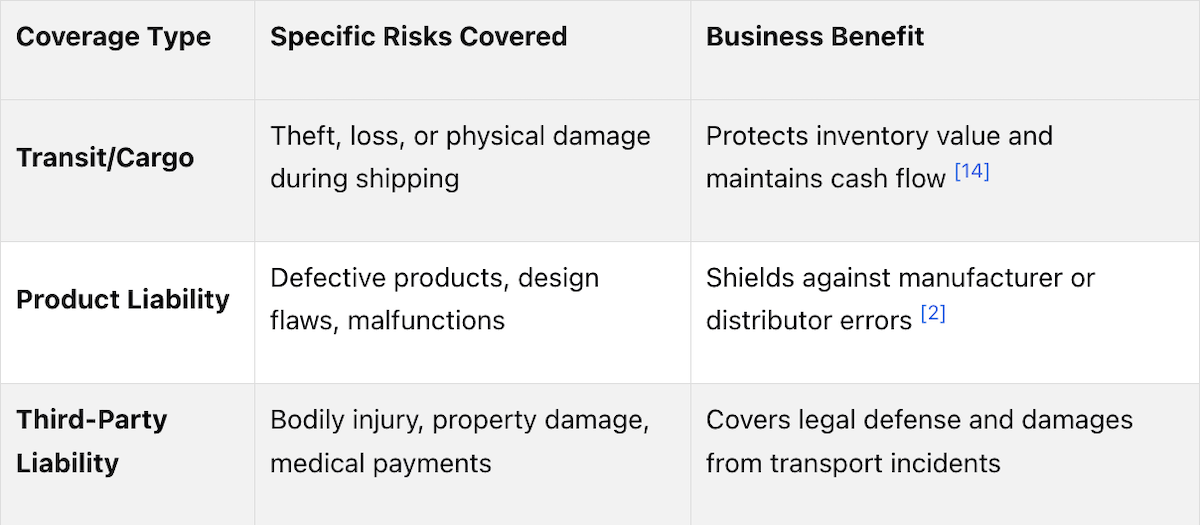
When firearms go missing during transit, specialized transport liability insurance steps in to cover the full agreed value of your inventory. Unlike general shipping policies that often exclude firearms, these tailored policies ensure you’re compensated based on a pre-determined value rather than a depreciated one [1]. This protection applies to both domestic and international shipments [14], helping you maintain cash flow and keep your operations running smoothly. While theft is a major concern, protecting your inventory from physical damage is equally important.
Transit can be rough on firearms, with risks like collisions, fires, or mishandling potentially damaging your inventory. Policies offering transit and cargo coverage shield you from these scenarios [14]. For example, motor truck cargo insurance specifically covers damage caused by theft, fire, or accidents [17]. Unlike standard carrier insurance, which often imposes strict limits, specialized policies are designed to match the value of your inventory. This is particularly critical when transporting serialized parts or ammunition - items frequently excluded by general carriers [1]. Beyond safeguarding your inventory, these policies also address liabilities involving third parties.
Third-party liability is a serious concern for firearms businesses. If someone is injured or property is damaged during transit, Commercial General Liability (CGL) policies provide essential protection by covering both legal defense costs and any damages awarded [16]. Even a single incident can lead to massive financial exposure - for instance, accidental discharges accounted for 1.0% of all firearm-related deaths in 2022 [15]. Some policies also include Medical Payments coverage, which provides immediate funds for injuries sustained by non-employees during transport without requiring litigation.
Additionally, product liability coverage offers a safety net for situations where a firearm you transported is later found to be defective or causes harm due to design flaws. This type of protection shields you from manufacturer or distributor liability claims [2]. Working with specialized insurers, such as Joseph Chiarello & Co., Inc., ensures your policy addresses these niche risks that general policies often overlook.
Choosing the right transport liability insurance means understanding your specific risks and finding coverage that fits your needs.
Start by identifying the types of items you transport - whether it’s complete firearms, serialized parts, or ammunition. For such shipments, specialized transit insurance often provides higher coverage limits [1]. Consider whether your shipments are domestic or international, and factor in your monthly transport volume to ensure your coverage aligns with your risk exposure [14]. Policies can be tailored for domestic or international shipping needs [14].
One key feature to look for is agreed-value claims coverage. This type of policy allows you and your insurer to pre-determine the value of your inventory, helping you avoid disputes over depreciation in the event of a loss [1].
Lastly, take a close look at the policy’s inclusions and exclusions to ensure it offers the protection you need.
Carefully review the policy for features like inland transit coverage and bundled extensions, such as those offered by Firearms Business and Property Insurance. Standard carrier policies often have restrictive limits and exclusions for firearms, which could leave you underinsured [1]. A good policy should explicitly include inland transit coverage to protect your goods while they’re being transported.
Another important consideration is whether the policy is "occurrence-based" or "claims-made." Occurrence policies cover incidents as long as they happened during the policy period, even if the claim is filed later. Claims-made policies, on the other hand, only cover claims filed while the policy is active. Occurrence-based policies generally offer better long-term protection, especially for transport-related claims that might arise years after the fact.
Be aware of common exclusions, such as those for intentional acts, criminal behavior, poor maintenance, or preventable third-party claims. If your business involves handling firearms on consignment or providing gunsmithing services, ensure the policy includes coverage for "property of others in your care and control", as many standard property policies exclude this.
"If a customer is injured in your store, it could put you in bankruptcy, even if it's just a simple slip and fall. A five-figure legal bill plus an award to the injured party is not unusual, and can easily grow to six figures or more." - Jack Napier, Claims Manager, Joseph Chiarello & Co. [18]
Regularly reviewing your policy with a specialized provider is crucial to maintaining comprehensive protection.
General insurance agents often lack the expertise needed for firearms transport liability. That’s why working with a specialized provider who understands the industry is so important. Look for providers with decades of experience - 40 years or more is a good indicator of deep knowledge [19][14].
For example, Joseph Chiarello & Co., Inc. specializes in firearms industry insurance and partners with carriers like AIG. They understand federal transport laws (§ 478.38) and how compliance impacts your coverage. This expertise ensures your policy avoids "criminal act" exclusions, which could void claims if transport methods aren’t properly documented.
Specialized brokers can also perform a coverage audit to identify potential gaps. They’ll help you balance premiums and deductibles - higher deductibles can lower monthly costs but require more upfront cash during a loss [20]. It’s also a good idea to review your policy annually to ensure it reflects your current inventory and operations. Always provide full operational details to your insurer; withholding information could give them grounds to deny a claim later.
Having the right insurance is just one piece of the puzzle. The other is using practical risk management strategies to protect your business and keep costs under control. These strategies not only safeguard your inventory but also ensure you're meeting the requirements of your insurance coverage.
Federal law mandates that firearms must be transported unloaded and stored in locked, hard-sided containers [21]. Additionally, carriers are prohibited from labeling packages to indicate they contain firearms, reducing the chances of theft during transit [4].
It's crucial to verify shipment contents against the manifest immediately upon receipt and update your bound book no later than the next business day [13][3]. This is especially important considering that, in 2020, nearly 15,000 reports of stolen or missing firearms were made to the ATF by federally licensed dealers [13].
When conducting inventories, always have at least two witnesses present [13]. Keep backup records - like insurance policies, supplier lists, and digital copies - stored securely at an offsite location [3]. Physical security measures are important, but having well-trained employees is just as vital for reducing transport risks.
Your employees play a critical role in preventing transport losses. Conducting thorough background checks ensures that staff are not classified as "prohibited persons" under 18 U.S.C. § 922(g) - this includes individuals with felony convictions, domestic violence misdemeanors, or substance abuse issues that legally disqualify them from handling firearms [22].
The ATF advises annual re-screenings instead of relying solely on pre-employment checks, as an employee's legal status can change due to new restraining orders or convictions [22]. Employees should be required to report any changes in their legal status within 24 hours [22].
Training is equally important. Teach your team about data privacy requirements under the Fair Credit Reporting Act (FCRA) to protect sensitive transport and client information. Retain all background check records and training certificates for five years to stay prepared for audits [22].
Security measures and employee protocols are only part of the equation. Regularly reviewing your insurance policies ensures they align with changing risks. As your business grows - whether through increased inventory, additional transport routes, or new equipment - your insurance coverage must adapt to avoid being underinsured [23].
Schedule annual reviews with your broker to ensure your policy reflects current asset values and operational needs. Update your coverage immediately if you acquire high-value inventory or transportation equipment [23]. If you're handling firearms for repair, confirm that your policy includes Bailee's coverage to protect non-owned property in your possession [25]. Also, check that your policy provides upfront legal defense funds rather than requiring reimbursement, which can help you avoid delays during a lawsuit [24].
Firearms transport liability insurance acts as a critical financial safety net, shielding your business from potential lawsuits, regulatory fines, and devastating financial losses. Standard general liability policies, with coverage caps between $1 million and $2 million, often fall short when dealing with the high costs of firearms-related legal disputes and settlements. This is where specialized transit insurance steps in, offering higher coverage limits and agreed-value claims to protect firearms, serialized parts, and ammunition in transit.
These protections are even more important given the current regulatory landscape. Federal law requires FFLs to report in-transit thefts within 48 hours, with nearly 15,000 such reports filed with the ATF in 2020. On the state level, laws like California's SB 505 and New York's S4946 mandate liability insurance for firearm owners, with New York setting a minimum coverage of $1 million. This makes carrying written proof of insurance during transport not just a good practice but a legal necessity in certain jurisdictions [26][27][28].
Here are some practical steps to consider:
Beyond insurance, bolster your risk management strategy with additional security measures. Perform thorough employee background checks, implement GPS tracking for high-value shipments, and store backup records in secure offsite locations. These steps not only reduce risk but also show insurers that you’re committed to protecting your assets. With legal defense costs capable of crippling a business, specialized insurance ensures those expenses are covered upfront, avoiding delays and keeping your operations running smoothly during litigation.
General liability insurance (CGL) usually doesn’t cover risks tied to transporting firearms. If your business involves moving firearms, you might need specialized firearms transport liability insurance to address those specific risks. This type of policy can complement your existing CGL coverage, ensuring broader protection for transportation-related liabilities.
When shipping firearms or ammunition, failing to notify the carrier about the contents can result in voided coverage. Similarly, violating federal regulations - like improperly labeling shipments to show they contain firearms - can also void your coverage. Federal law prohibits such labels and mandates notifying the carrier. To keep your coverage intact, always follow the required regulations.
Agreed-value claims work by determining a fixed value for firearms, parts, and ammunition before they are transported. If these items are lost or damaged during transit, the insurer compensates the pre-determined amount rather than assessing the actual loss or damage. This approach streamlines and accelerates the claims process.
Don't wait until it's too late to make sure your gun shop is covered. At Joseph Chiarello & Co., Inc., we’re here to help you navigate the ins and outs of gun shop workers compensation insurance to ensure you're prepared for any noise-related risks, including hearing damage. Reach out to us today to review your current policy or get a customized quote. Protect your team and your business with the right coverage—because their safety is worth it.
Call Now: 800-526-2199. Or submit your inquiry below. We look forward to having the opportunity to work with you!