

What is loss control in firearms businesses?
Loss control is a proactive safety and security program that reduces theft, injuries, and liability, lowering insurance claims and costs.
How does loss control help reduce insurance premiums?
By lowering claim frequency and severity, insurers offer better rates and improved coverage options.
What loss control steps prevent firearm theft?
Locked cases, limited customer access, strict key control, alarm systems, cameras, and regular inventory audits.
Why does employee training matter in loss control?
Proper training reduces accidents, improves compliance, and prevents costly workplace injury claims.
How often should firearm inventory be audited?
At least once a year, with secure recordkeeping and prompt reporting of discrepancies.
What are the long‑term benefits of a loss control program?
Better loss ratios, lower premiums, improved insurability, stronger compliance, and more stable operations.
•••
For firearms businesses, these strategies not only cut costs but also improve compliance and operational stability.
Taking proactive steps to minimize risks can significantly cut down on insurance claims. For the firearms industry, focusing on three main areas - workplace safety, inventory security, and customer/facility safety - helps address potential hazards effectively.
Workplace safety is a cornerstone of risk management. For firearms businesses, especially those with indoor ranges, challenges like lead exposure and noise hazards are common. To combat these, specialized ventilation systems, regular lead testing, HEPA-filter vacuums, and lead-specific cleaning agents are essential tools. Noise hazards can be reduced by installing sound-absorbing panels, providing high-quality hearing protection, and rotating shifts to limit prolonged exposure [4].
Proper employee training is equally important. A three-step firearm clearing process (removing the magazine, opening the breech, and inspecting the chamber) minimizes accidental discharges [3]. Storing ammunition separately from firearms and out of customer reach further enhances safety [2][3]. Additionally, de-escalation training equips staff to handle challenging customer situations, while ergonomic assessments help prevent repetitive motion injuries, reducing related claims [4][5].
By addressing these risks, businesses create a safer work environment, laying the groundwork for better inventory and customer safety practices.
Protecting inventory is another critical component of loss control. Strong internal controls can significantly reduce theft, whether from shoplifting or employees. Simple measures like keeping display cases locked and limiting customer access to one firearm at a time can make a big difference [2][6]. Data from 2022 highlights the impact of burglaries, larceny, and inventory discrepancies, with pistols being a major target [1].
Conducting regular physical inventories - at least annually - helps identify issues early, distinguishing between recordkeeping mistakes and actual theft [2][7]. Advanced monitoring systems with cellular backup, interior motion detection, and glass breakage sensors ensure alarms stay functional even if primary systems fail [2]. Strategically placed cameras that capture clear facial images and eliminate blind spots, along with strict key control policies (like limiting vault access and updating alarm codes after staff changes), further protect inventory [6]. Promptly reporting theft or inventory loss to the ATF and local law enforcement within 48 hours is not just a best practice but a regulatory requirement [2][1].
Safety measures for customers and facilities go hand in hand with technical safeguards. Educating customers on safe handling - such as proper clearing and unloading techniques - and designing facilities to eliminate blind spots are key steps. Ensuring employees never leave customers unattended with inventory and adopting a "one firearm at a time" policy during transactions help reduce risks of theft and accidental discharges [8][3].
Additional precautions, like enforcing the use of ear and eye protection on firing ranges, align with federal requirements to provide or offer firearms safety and locking devices to buyers [3]. Cable trigger guards on display models and a comprehensive disaster preparedness plan for events like fire, flooding, or looting further enhance overall safety [3].
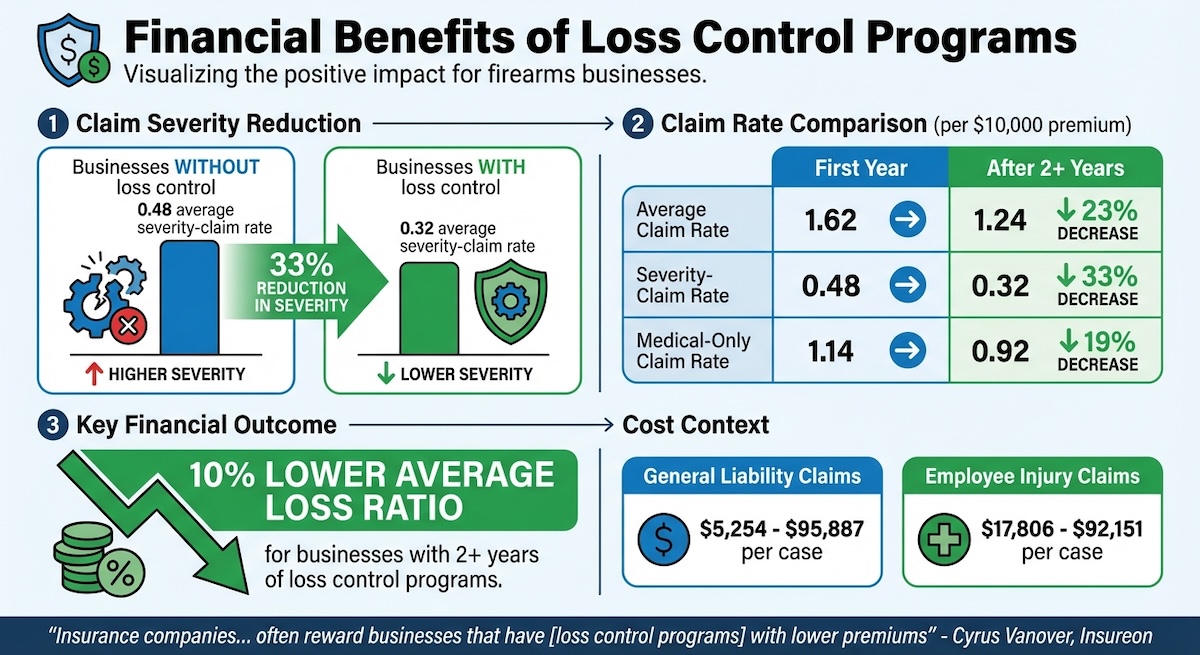
Loss control strategies do more than just prevent incidents - they also bring measurable financial advantages. Firearms businesses that adopt robust risk management practices can save money through reduced claim severity, quicker claim settlements, and lower insurance premiums. These savings align with the earlier discussion on reducing claim frequency.
Effective loss control measures can stop minor issues from turning into major financial setbacks. For example, installing fire suppression systems, security cameras, and alarm systems safeguards valuable and specialized inventory. As the ATF points out, "The cost of security outweighs the risk of theft" [2]. Physical measures like deadbolts, motion detectors, and secure storage protocols further minimize the need for costly interventions after an incident occurs [9]. Studies reveal that businesses with established loss control programs report an average severity-claim rate of 0.32, compared to 0.48 in businesses without such measures [11].
Strong risk management practices also simplify the claims process. When incidents happen, businesses with thorough safety protocols, regular inspections, and detailed records can provide clear and organized evidence during investigations. Michael E. Nave from California State University states, "A loss control service strategy that provides service flexibility and develops partnership between employer and consultant can help reduce the frequency and severity of workers' compensation claims" [11]. This efficiency shortens the time needed to resolve claims, minimizing operational disruptions and helping businesses resume normal activities faster.
Insurance providers often reward businesses with loss control programs by offering lower premiums. Cyrus Vanover, a contributing writer for Insureon, explains: "Insurance companies encourage the development of loss control programs to reduce insurance claims and often reward businesses that have them with lower premiums" [9]. Data shows that businesses engaged in loss control for two or more years experienced an average claim rate of 1.24 per $10,000 in premium, compared to 1.62 during their first year. Additionally, these businesses achieved a 10% lower average loss ratio, reducing the likelihood of premium hikes caused by frequent claims [11].

Firearms businesses can benefit from specialized loss control services designed to identify risks and minimize claims. These services go beyond standard insurance by actively working to reduce exposure to potential issues.
Risk assessments thoroughly evaluate every aspect of a firearms business to pinpoint vulnerabilities that could lead to theft, regulatory violations, or property damage. These inspections focus on structural weaknesses such as unsecured doors, faulty locks, and thin walls. This is particularly important because criminals often exploit weak points, even cutting through walls of neighboring businesses with insufficient security [2][3]. Additionally, they assess whether adjacent properties pose risks due to their own lack of security measures [2][3].
The findings are compiled into a detailed report with recommendations tailored to the business's specific needs. Common solutions include installing concrete bollards to deter vehicle-based "smash-and-grab" thefts [5][2][3]. For disaster preparedness, these assessments also help businesses create multi-hazard plans to protect against fires, floods, and hurricanes. This includes securing both physical inventory and digital records like Acquisition and Disposition logs [10][3]. The ATF provides resources, such as their "Loss Prevention for Firearms Retailers" guide, to aid in evaluating structural security and crafting prevention strategies [2].
Once risks are identified, businesses can implement safety upgrades, supported by systematic training to ensure employees follow through effectively.
Employee training and ongoing compliance checks are critical to reducing accidents and avoiding regulatory violations. Research shows that 80% to 95% of workplace accidents result from unsafe behaviors rather than equipment issues. This makes standardized training a key factor in maintaining safety. John Bocker from the NSSF Security Consultant Team highlights:
"A safety program is likely to be more effective when employees at all levels are involved. Standardized policies should outline responsibilities and accountability for all staff members" [13].
The importance of compliance cannot be overstated. In fiscal year 2022, the ATF conducted 6,979 compliance inspections, and only 54% of businesses were free of violations. Non-compliance can lead to severe criminal penalties and even firearms being linked to violent crimes.
Regular employee training focuses on critical areas such as inventory management, secure display practices, and alarm system operation. These measures directly reduce the severity of claims. OSHA emphasizes:
"Well-developed emergency plans and proper worker training... will result in fewer and less severe worker injuries and less damage to the facility during emergencies" [12].
Considering that general liability claims can range from $5,254 to $95,887 per case, and employee injury claims can cost between $17,806 and $92,151, consistent training is a financial safeguard for firearms businesses.
In addition to on-site measures, support from insurers plays a vital role in strengthening a business's financial and regulatory position. Insurer-supported loss control services help reduce risks, lower claim rates, and even decrease premiums. For example, Joseph Chiarello & Co., Inc. offers a range of loss control services alongside their insurance products, including Workers' Compensation Insurance, Firearms Business and Property Insurance, and Commercial General Liability Insurance. Their offerings include safety audits, risk identification specific to firearms operations, and ongoing compliance support tailored to ATF regulations and industry standards.
Insurers also help businesses establish practical protocols, such as conducting regular inventory checks to quickly identify discrepancies [6][2]. They provide guidance on implementing advanced security measures like cellular-backup alarms, motion detectors, and secure display case procedures [6][2]. This partnership ensures firearms businesses receive expert advice to reduce claim frequency while staying compliant with industry regulations. This is particularly crucial in an industry where over 17,000 firearms were reported lost or stolen in 2022.
Firearms businesses that invest in loss control over the long term often see noticeable financial improvements. For example, a study in the Journal of Safety Research examined 82 California employers and found that those working with loss control consultants for at least two years achieved an average loss ratio that was 10% lower than businesses without such programs. They also reduced their average claim rate from 1.62 to 1.24 per $10,000 of premium [11]. This kind of sustained effort not only decreases the frequency and severity of claims but also helps businesses avoid sudden rate hikes. With fewer claims, companies are less likely to face the sharp premium increases that come after multiple filings [10]. This creates a more predictable financial environment, helping businesses preserve their capital and maintain stability.
Strong loss control measures can significantly improve how firearms businesses are viewed by insurers. Companies with solid safety records and proactive risk management often qualify for lower premiums and better access to admitted policies, which offer more comprehensive and long-term coverage [10][5]. This is especially valuable in an industry where over 17,000 firearms were reported lost or stolen in 2022 [1]. Beyond the financial perks, loss control boosts a company's reputation, operational strength, and employee morale. According to Michael E. Nave from California State University:
"A loss control service strategy that provides service flexibility and develops partnership between employer and consultant can help reduce the frequency and severity of workers' compensation claims" [11].
These benefits go beyond short-term savings, creating a stronger foundation for long-term success.
The financial benefits of loss control become even clearer when looking at specific examples. A white paper published in 2025 by Whisker Labs and Triple-I highlighted the impact of IoT technology in loss control. By the third year of implementation, the technology reduced electrical fire claims by 63%, saving $81 per customer [14]. Similarly, the California employer study showed that after two years of employing a flexible loss control strategy, businesses not only reduced their overall claim rate but also lowered their medical-only claim rate from 1.14 to 0.92 [11]. These kinds of improvements add up over time, reinforcing the company’s financial health and strengthening its competitive position in the market.
Loss control plays a key role in lowering both the frequency and cost of insurance claims for firearms businesses. By spotting risks early, companies can avoid accidents, theft, and liability issues that might otherwise result in costly claims and premium increases [5]. Fewer claims mean greater financial stability and help businesses avoid premium hikes [10].
Implementing strong safety measures - like regular inventory checks, layered security systems, and thorough disaster plans - can also lead to lower premiums and better coverage [5]. These steps not only protect a company’s reputation but also ensure operations can quickly recover from incidents like fires or theft [5][10]. With over 17,000 firearms reported lost or stolen in 2022, the importance of effective loss control cannot be overstated [1].
These efforts often lead to valuable partnerships, improving both coverage and support. For example, companies that worked with loss control consultants for two or more years saw their average loss ratio drop by over 10%, with claim rates decreasing from 1.62 to 1.24 per $10,000 of premium [11]. As highlighted in a NIOSH study:
"A loss control service strategy that provides service flexibility and develops partnership between employer and consultant can help reduce the frequency and severity of workers' compensation claims." [11]
Firearms businesses can benefit from working with Joseph Chiarello & Co., Inc., which provides specialized insurance solutions alongside loss control services, risk assessments, and claims support. Their tailored approach not only ensures comprehensive coverage but also promotes a culture of safety, delivering measurable improvements and financial gains that support long-term business success.
To bring down your insurance premiums fast, prioritize putting strong safety protocols in place, enhancing security measures, and staying fully compliant with relevant laws and regulations. These actions minimize risks and show your insurer that you're actively working to prevent potential losses.
Keeping thorough records is essential. Document contracts, policies, employee training, and inventory meticulously. If there's ever a theft or loss of firearms, make sure to log the date and full details in your acquisition and disposition records. This not only speeds up claim processing but also helps you stay compliant with regulations.
Make it a priority to carry out firearm inventory audits on a regular basis, ideally during non-business hours to avoid disruptions. Aim to perform these audits at least once a year. Regular checks ensure your records stay accurate and help reduce the chances of theft or loss.
Don't wait until it's too late to make sure your gun shop is covered. At Joseph Chiarello & Co., Inc., we’re here to help you navigate the ins and outs of gun shop workers compensation insurance to ensure you're prepared for any noise-related risks, including hearing damage. Reach out to us today to review your current policy or get a customized quote. Protect your team and your business with the right coverage—because their safety is worth it.
Call Now: 800-526-2199. Or submit your inquiry below. We look forward to having the opportunity to work with you!