
A low workers’ comp premium can turn into a much bigger bill later. If you run a gun shop, range, or gunsmith business, the main trouble spots are usually the same: wrong class codes, contractor mix-ups, lead and noise exposure gaps, a policy built for the wrong type of work, and state rule mistakes.
Here’s the short version:
A few numbers make the risk plain: research says about 75% of workers’ comp premium audits contain errors, one audit reclassification added $6,146 for a single worker, and indoor range testing has found lead air levels at 64 µg/m³, above OSHA limits tied to medical surveillance rules.
If I were reviewing this before renewal, I’d focus on five checks first:
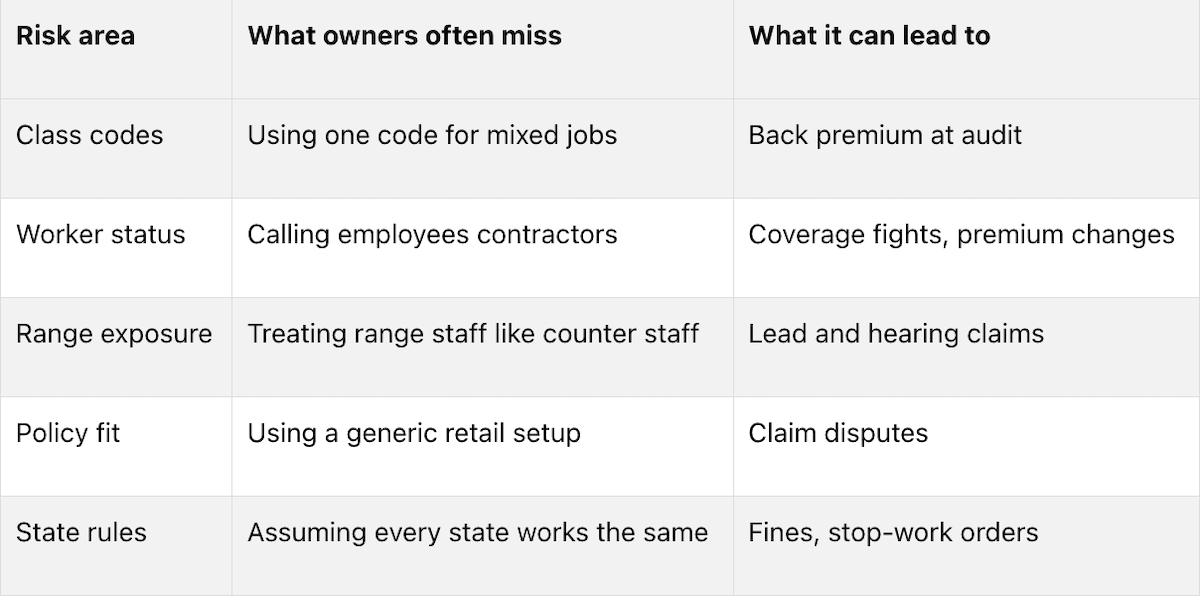
Bottom line: workers’ comp for firearms businesses is not a set-it-and-forget-it policy. The best time to fix mistakes is 60 to 90 days before renewal, before an audit, injury claim, or state review does it for you.
Before renewal, split payroll by what each person actually does, not by job title.
That sounds simple. But it trips up a lot of firearms businesses.
Workers' comp is priced by payroll class code. So when a business puts people into the wrong code, it can look like premiums are lower during the policy term. Then the audit shows up, and the bill changes fast.
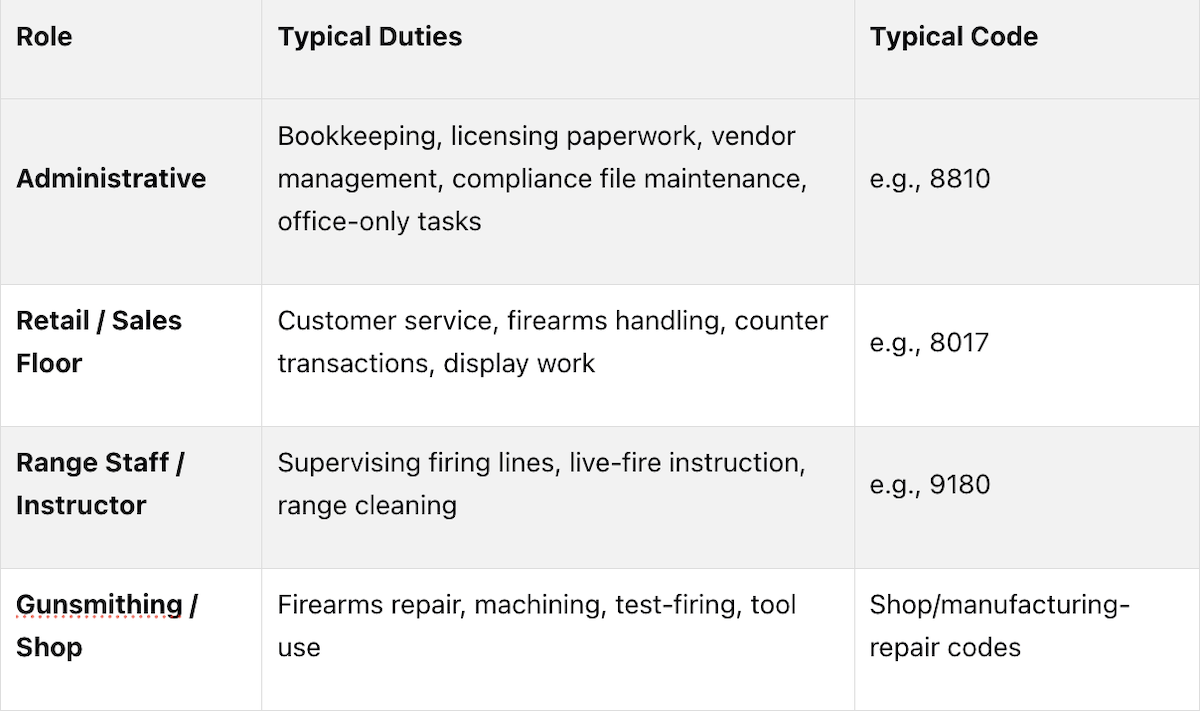
The main issue is treating every firearms employee like the same kind of risk. They aren't. An office bookkeeper, a sales associate handling firearms at the counter, and a range safety officer supervising live fire all have very different risk levels. If you group them under one lower-rated code, the premium can stay artificially low until the audit catches it.
Clerical code 8810 applies only when the employee works exclusively in an office, with no sales floor, range, or shop duties. If an office manager sometimes steps onto the sales floor or helps behind the counter, that person's full payroll will often move to the next applicable code.
Retail sales employees usually fall under a moderate-hazard code such as 8017 (Stores: Retail NOC) because the job involves regular customer contact, firearms handling, and inventory handling. [10]
Range officers and gunsmiths are a different story. Range officers supervise live-fire lines, deal with malfunctions, and work around high noise and airborne lead. Gunsmiths use power tools, solvents, and machinery, which puts their risk closer to light manufacturing than retail. Shooting range operations are often placed under codes such as 9180 (amusement operations - shooting clubs) or state-specific codes. [8]
After the policy period ends, the auditor reviews payroll records and job descriptions. If payroll was put in the wrong class, that payroll gets moved to the right code, often a higher-cost one, and the full-year premium is recalculated. Then the carrier sends a bill for the difference.
And this isn't a small paperwork issue.
One audit example showed that moving a single employee's payroll from clerical code 8810 to a higher-cost machinery manufacturing class led to an added premium of $6,146 for that one worker. [11]
For a firearms business with several range staff members or gunsmiths coded as clerical or basic retail, that math can snowball in a hurry. If someone gets hurt, the carrier may also question coverage when the claim is filed.
Once class codes are fixed, contractor status becomes the next audit risk.


Calling someone an independent contractor doesn't make it so. For workers' comp, regulators look at how the job works in practice: who sets the schedule, who provides the tools, and who controls the work. If a range safety officer works set shifts, follows your range's safety rules, and uses your lanes and equipment, that worker will likely be treated as an employee for workers' comp purposes no matter what the contract says or how taxes are filed.[5]
If there's any doubt, treat the worker as an employee. When someone works like an employee, workers' comp usually sees them that way too.
There’s also ATF risk here. If you treat a screened employee like a contractor, you can leave prohibited-person issues and insurance gaps sitting in plain sight.[14][19]
Once you've fixed worker status, the next problem is just as big: was the job rated for its actual exposure?
A lot of firearms businesses rate range employees the same way they rate counter staff. That's where things go off the rails.
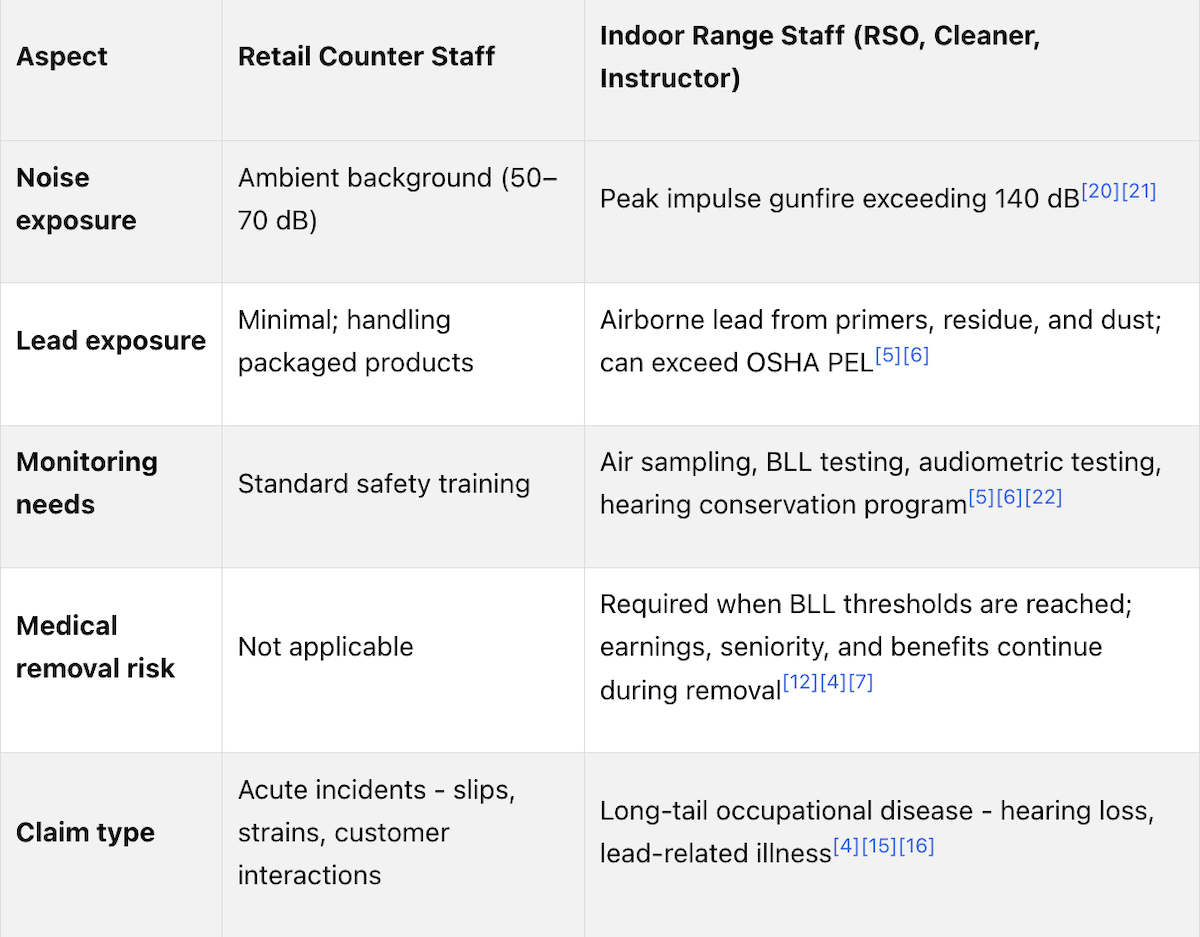
OSHA's lead standard, 29 CFR 1910.1025, sets an action level of 30 µg/m³ and a permissible exposure limit of 50 µg/m³ for airborne lead over an 8-hour time-weighted average.[5][6] If exposure meets or exceeds that action level for more than 30 days in a year, medical surveillance is mandatory.[5][4][6] And this isn't some far-off paper risk. A 2013 NIOSH review of a California indoor range found lead concentrations of 64 µg/m³ during cleaning tasks, with employee blood lead levels ranging from 19.9 to 40.7 µg/dL - high enough to trigger county public health alerts.[1]
Then there's the part many owners miss: Medical Removal Protection, or MRP. If a worker's BLL hits OSHA's removal threshold - an average of 50 µg/dL or a single reading of 60 µg/dL under the general industry rule - the employer has to remove that person from lead exposure for a period of time and keep paying earnings, seniority, and benefits during that removal, often for up to 18 months.[12][4][7] Whether the business budgeted for that or not doesn't matter.
Lead illness also tends to show up late. That's what makes it a long-tail claim. The harm can surface well after renewal, which is why pre-renewal review is the right time to spot the gap.
Hearing loss usually doesn't come from one bad day. It builds slowly, shift after shift, from repeated high-decibel impulse noise in an enclosed range.
Studies have recorded peak sound pressure levels at indoor ranges from 156 to 170 dB. That's far above OSHA's impulse-noise limit of 140 dB peak SPL.[20][21] OSHA's hearing conservation program starts at 85 dBA as an 8-hour time-weighted average, and NIOSH says range workers should use double hearing protection, adding 15 to 20 dB of peak reduction beyond standard earmuffs or earplugs.[17][20][22]
Just like lead claims, hearing loss claims can show up years after the exposure. And if you don't have baseline audiograms, written noise measurements, and steady PPE records, those claims get much harder to sort out.
Here's why range jobs and retail counter jobs should not be treated the same way:
Even when the class code is right, the policy can still miss the mark if it's too generic for firearms work.
Even if you get class codes and worker status right, the policy can still miss the mark. A standard workers' comp policy is usually built for plain retail or light industrial work. That doesn't line up with what happens inside a gun shop, shooting range, or gunsmithing business.
The issue is simple: the policy may be written for the wrong kind of work. A gunsmith, a shipping employee, and a range worker do very different jobs, and each one faces a different set of injury and exposure risks. As covered earlier, range staff can also face long-term lead and noise exposure that standard retail underwriting doesn't account for.[3][23][4][16][5][13][18]
That mismatch can get expensive fast. If a claim is filed and the insurer reviews what the business disclosed during underwriting, any gap between the policy's assumed risk and the company's actual operations can lead to disputed claims, audit-driven reclassifications, and retroactive premium charges. The worker ends up stuck in the middle, while the employer deals with the cost.[3][23]
The fix is straightforward: match each role to the right class code and build the policy around what the business actually does. The 60- to 90-day pre-renewal audit window is often the best time to catch and fix underwriting errors before they turn into claim or premium disputes. Firearms specialist Joseph Chiarello & Co., Inc. (guninsurance.com) builds coverage around that type of risk profile.[9]
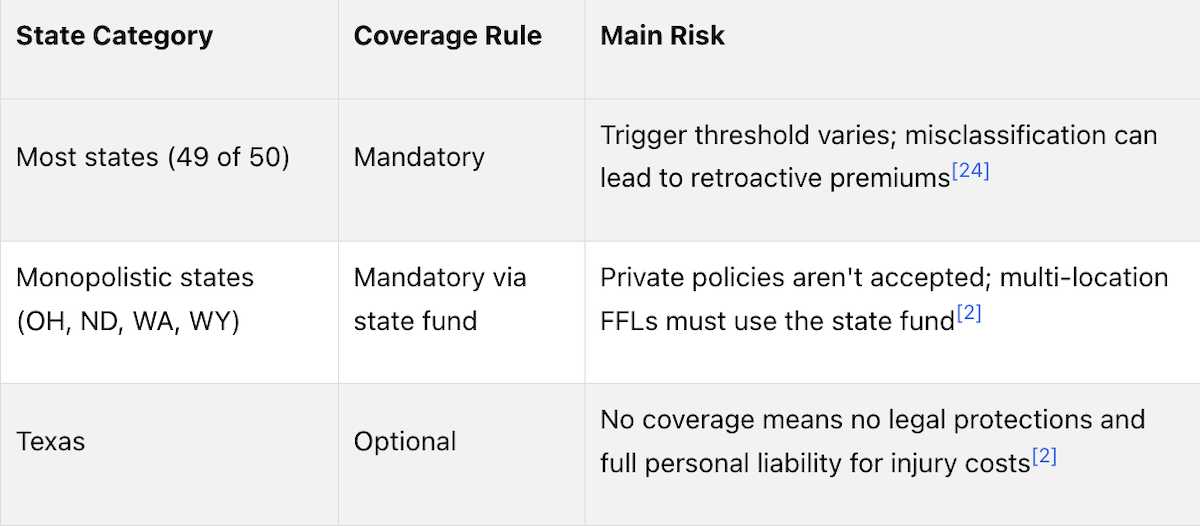
The gap can get even bigger when state law changes the rule itself. Workers' comp rules differ by state, and those differences hit hardest for FFL holders with mixed operations or locations in more than one state.
Even the coverage trigger changes from state to state. Some require coverage as soon as you hire your first employee. Others don't require it until you reach three to five employees.[24] Four states - Ohio, North Dakota, Washington, and Wyoming - are monopolistic, which means private insurance is not allowed and coverage must come through the state-run fund.[2] Texas is the outlier in the other direction. It's the only state where private employers can legally opt out of workers' comp, but that choice strips away key legal protections and leaves the employer personally liable for all injury costs.[2]
If a business fails to keep required coverage in place, or misclassifies workers to cut premiums, regulators can step in with stop-work orders, retroactive premiums, and fines.[24] That's why the pre-renewal period matters so much. It's the time to review each location, check the rule in each state, and fix the policy before renewal.
Use the 60- to 90-day window before renewal to catch class-code issues, contractor problems, exposure gaps, and policy mismatches before an audit or claim brings them to light. The goal is simple: fix these items before renewal, not after the damage is done.
Start with payroll. Break payroll out by the work people actually do, then compare each job to the class code now assigned to it. Office staff, counter sales employees, and range or gunsmithing roles shouldn't all sit under one broad class. If a worker is rated lower than their day-to-day duties support, reclassification at audit is a real risk.
Next, look at every contractor relationship. Pay close attention to anyone with set hours, access to your facility, and use of your equipment. In many cases, calling someone a contractor doesn't hold up if they work like an employee.
For range staff, make sure lead monitoring, medical surveillance records, hearing conservation records, and PPE logs are current.[5][25][26][27][21]
Use this checklist to review each risk area before renewal:
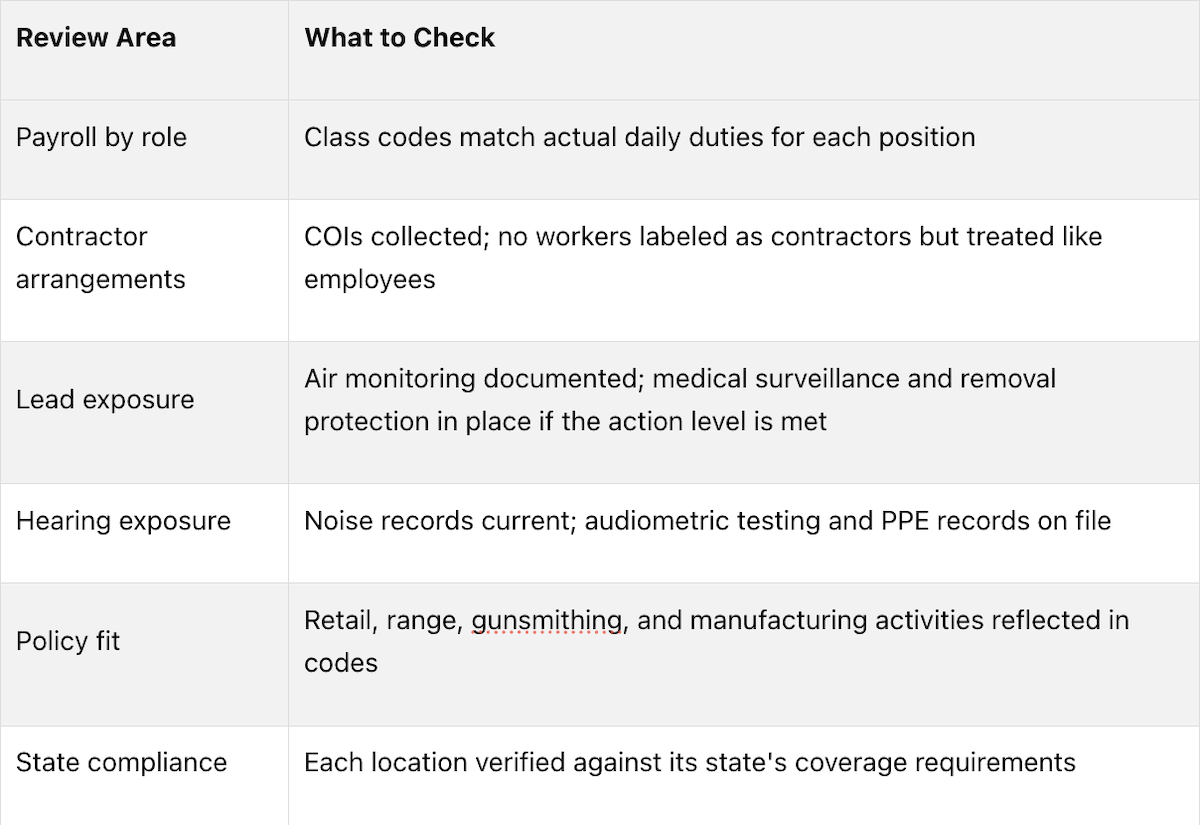
Also check that each location is listed under the right state and jurisdiction, especially in monopolistic states.[2]
Workers' comp needs to line up with how the business runs in practice. When it doesn't, the result can be retroactive premiums, fines, and stop-work orders. On top of that, injured workers may end up dealing with disputed or denied claims.
Joseph Chiarello & Co., Inc. (guninsurance.com) has spent 40+ years building workers' comp programs for firearms businesses, including gun shops, ranges, gunsmiths, and manufacturers.
Review your current class code assignments against what employees actually do day to day. One common red flag is putting someone in a low-risk administrative class code when that same person also works the retail floor, does gunsmithing, or helps with range duties.
Class codes should match the governing risk of the business. So in most cases, you’ll want to avoid splitting payroll unless an employee works only in a separate clerical role. Joseph Chiarello & Co., Inc. can help with industry-specific underwriting support and class look-up tools.
A worker’s status depends on the actual working relationship, not just the label in a contract. So even if someone signs a 1099 agreement, they may still be an employee if the business controls how, when, and where the work gets done.
The main test focuses on behavioral and financial control. In plain English, it asks whether the worker runs their own business or depends on the company for direction and income. Get that wrong, and the fallout can be serious: denied claims, penalties, and legal trouble.
Before renewal, review employee classifications and class codes to make sure they match each job. Pay close attention to administrative staff, retail workers, and anyone doing range or gunsmithing work. You should also confirm that independent contractors are classified the right way, which can help cut compliance issues and audit risk.
It’s also smart to look for coverage gaps tied to firearms industry hazards. That includes lead exposure and long-term hearing damage. Update payroll records, background screening files, and safety documents as needed, including OSHA-required medical monitoring for range staff.
Don't wait until it's too late to make sure your gun shop is covered. At Joseph Chiarello & Co., Inc., we’re here to help you navigate the ins and outs of gun shop workers compensation insurance to ensure you're prepared for any noise-related risks, including hearing damage. Reach out to us today to review your current policy or get a customized quote. Protect your team and your business with the right coverage—because their safety is worth it.
Call Now: 800-526-2199. Or submit your inquiry below. We look forward to having the opportunity to work with you!