

If your firearms policy was built like a standard small-business policy, there’s a good chance it won’t match your risk when a claim hits.
We see the same pattern over and over: the business is classed wrong, the form misses normal firearms exposures, the adjuster doesn’t know FFL records, and the carrier tightens terms or leaves the market after a few bad losses. For firearms businesses, that can mean claim delays, denied coverage, low sublimits, or a hard renewal.
Here’s the short version:
A few details stand out. California requires firearms dealers to carry at least $1,000,000 per incident in general liability coverage. New York requires two years of video retention and daily electronic record backups for dealers. If your policy was written like a plain retail account, those facts may not be built into the coverage review.
Quick Comparison
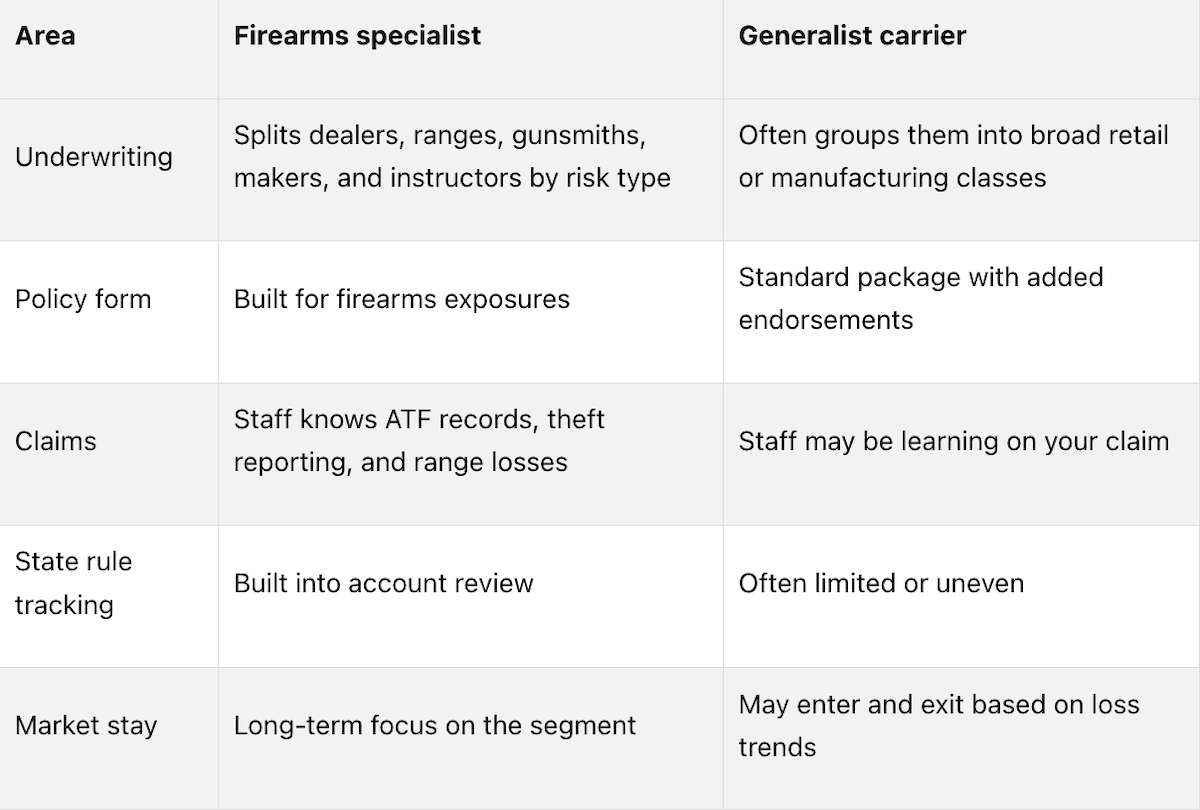
If we were reviewing a firearms policy today, on August 17, 2026, I’d start with classification, exclusions, sublimits, dealer stock values, customer firearms coverage, off-premises and transit terms, and whether gunsmith work is covered.

Generalist underwriters usually drop firearms businesses into broad buckets like sporting goods retailers, general manufacturers, or standard property risks. From that first label, they set pricing, limits, exclusions, and policy terms.
That sounds simple. The problem is that a firearms business is rarely simple.
A shop that sells firearms, runs a range, rents guns, and offers gunsmithing has four different risk profiles under one roof. Each one brings its own set of exposures. Gunsmithing introduces liability if a modified firearm later malfunctions and injures someone. Range operations bring premises liability tied to live-fire activity, lead exposure, and safety protocols. Rentals and customer firearms create property-in-your-care exposure. If a customer's gun is damaged or stolen while you're holding it, you may be on the hook.
Standard retail policy templates don't account for those details, and generalist underwriters often don't ask the kind of questions that would bring them to light.
That leads to two predictable problems:
The end result is a policy that may look broad on paper but doesn't line up with how the business actually runs. And once those bad assumptions are baked in, they don't stay in underwriting. They show up again when a claim is filed.
If the policy starts with the wrong assumptions, claims handling inherits the same blind spots. Adjusters without firearms industry experience can read normal FFL procedures as warning signs. Standard ATF-compliant steps like transfer paperwork, consignment, and repair intake may look suspicious to someone who doesn't know the space.
Theft and product liability claims are especially vulnerable. Stolen firearms bring mandatory ATF reporting rules and detailed inventory reconciliation. A generalist adjuster who doesn't understand A&D books and Form 4473s may treat recordkeeping gaps as a reason to limit or deny coverage, even when those records meet regulatory standards.
Product liability can get just as messy. An adjuster with no working knowledge of normal manufacturing tolerances or aftermarket modifications may get causation wrong from the start. That can drag out the claim while the business takes the hit, both financially and with its reputation.
Claims don't come in during calm moments. They show up after a fire, theft, or serious injury, when cash flow is already under pressure and every day counts. An adjuster trying to learn the industry on your claim isn't a small issue. It's a built-in risk.
The last weak point is commitment. Generalist carriers don't move into the firearms segment because they know it well. They move in because the numbers look good for a while. Then a few large claims hit, or reinsurance pressure changes the math, and that appetite can vanish fast.
The pattern is familiar: broad terms on the way in, tighter terms and non-renewals on the way out.
For an FFL or range, that kind of exit creates a scramble for replacement coverage in the middle of doing business, often on worse terms. A sudden lapse can put several things at risk at once:
As ATF and state enforcement priorities shift [1], carriers that haven't kept their terms current fall behind. Some won't bother to catch up. They'll just leave the segment. And when that happens, the businesses that relied on a carrier's short-run appetite are the ones left holding the gap.
A carrier can stay in the firearms market and still hand over the wrong policy. In many cases, the trouble starts with the form itself. Generalist carriers usually begin with standard commercial policies built for broad retail or manufacturing risks, then tack on endorsements to make them fit a firearms business. On paper, that can look fine. After a loss, the weak spots show up fast.
Dealer stock may be written under plain contents limits. Customer firearms often get pushed into low property-of-others sublimits. So if a rifle is damaged during a test fire or disappears from the shop, the policy may not react the way the owner expected. The same issue shows up with gun shows, transit, and on-site ranges. Those exposures are often capped, left unendorsed, or treated like side activities when they're part of normal day-to-day work.
Standard forms often fall short in these areas:
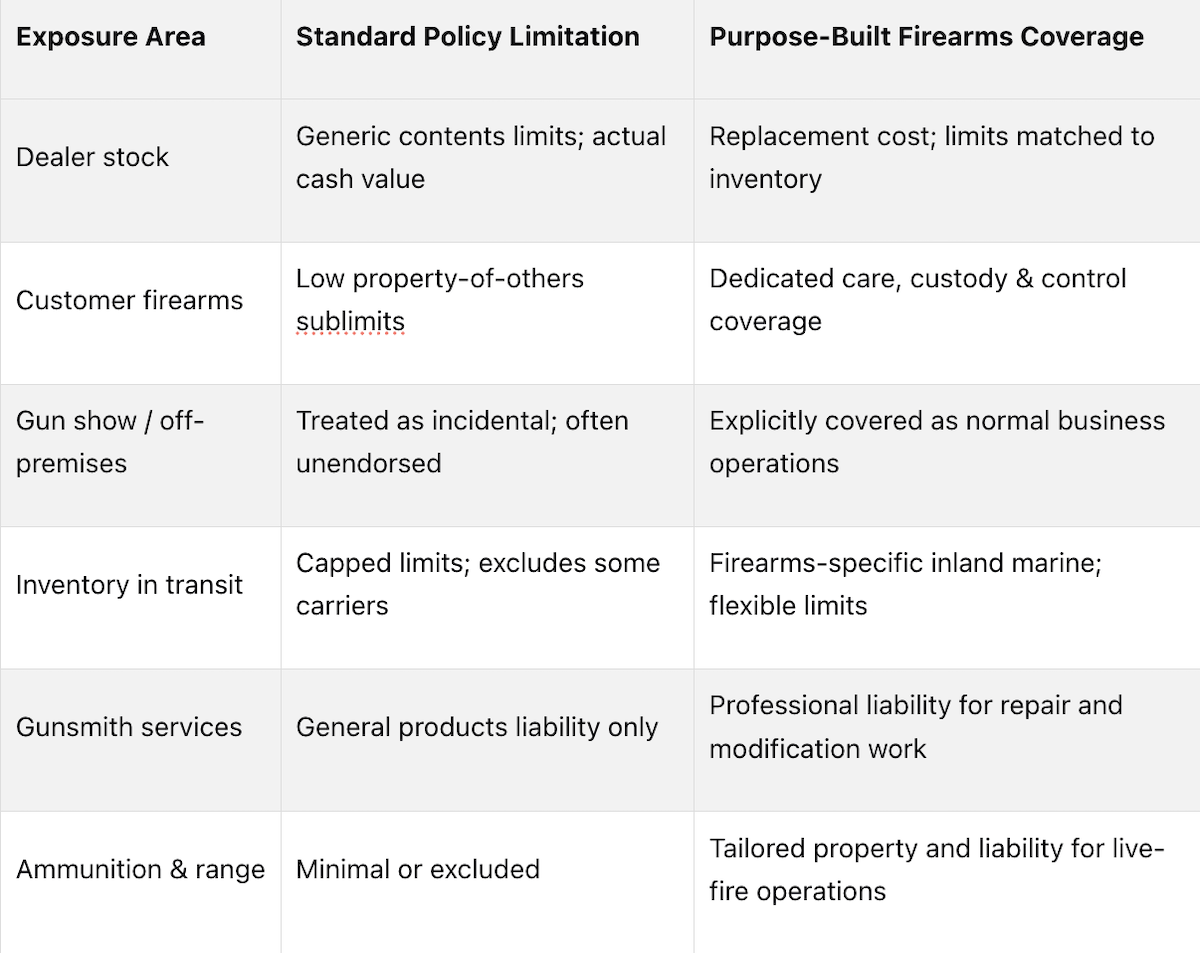
That’s the gap between a policy built for firearms operations and one stitched together after the fact.
Gunsmith professional liability is one of the easiest places for coverage to fall apart. Generalist carriers often treat gunsmithing as minor labor tied to retail sales, without looking at the separate exposure that comes with repair and modification work. Standard "professional services" exclusions can quietly carve out coverage for claims tied to a faulty repair or improper modification - the exact scenarios most likely to lead to a serious injury claim. A purpose-built policy treats gunsmith services as covered operations and lines up professional liability with products-completed operations coverage, so both the work and the finished product sit inside the policy’s scope.
Regulatory blind spots can turn a policy issue into a claims mess. FFLs work within bound books, Form 4473s, theft-or-loss reporting rules, and state laws that shape how losses are tracked and reviewed. [5][6][7][8] A generalist carrier that doesn’t know that framework may read a routine inventory discrepancy as a coverage issue instead of part of a regulatory process. That kind of mistake can slow down a valid claim or lead to a denial.
State rules add another layer, and this is where generalist underwriting often misses the mark. California, for example, requires licensed firearms dealers to carry at least $1,000,000 in general liability insurance per incident. [2] New York requires two years of video surveillance retention and daily electronic record backups for dealers. [2] A standard small-business policy written without those rules in mind may not meet the legal minimums. The problem may stay hidden until a claim is filed or the policy comes up for renewal.
Specialist underwriters account for these duties from day one. Joseph Chiarello & Co., Inc. has spent more than 40 years underwriting around FFL categories and state-specific obligations from the start.
It’s one thing to know a specialist and a generalist aren’t the same. It’s another to spot the difference before you sign a policy. That’s where things get real. The signs are easy to check, and that matters most before renewal, when a bad fit can get expensive fast.
Each marker below connects to one of the problem areas covered earlier. Put together, they give you a simple checklist for sizing up any carrier.
The first marker is about market exits: look for decades of continuous market presence.
The second deals with misclassification: a real specialist underwrites dealers, ranges, manufacturers, gunsmiths, and instructors as separate risk types, including mixed operations.
The third helps you catch coverage gaps: ask whether the form is purpose-built or retrofitted. Ask for a sample policy. Then check where entrusted firearms and range operations are named outright.
The fourth helps reduce claim problems: claims should be handled by in-house adjusters who understand firearms operations, ATF paperwork, and range incidents.
Before you commit to any carrier, ask these questions directly:
If the answers feel fuzzy or indirect, treat that as a red flag.
When answers are vague, a side-by-side view makes the gap plain.
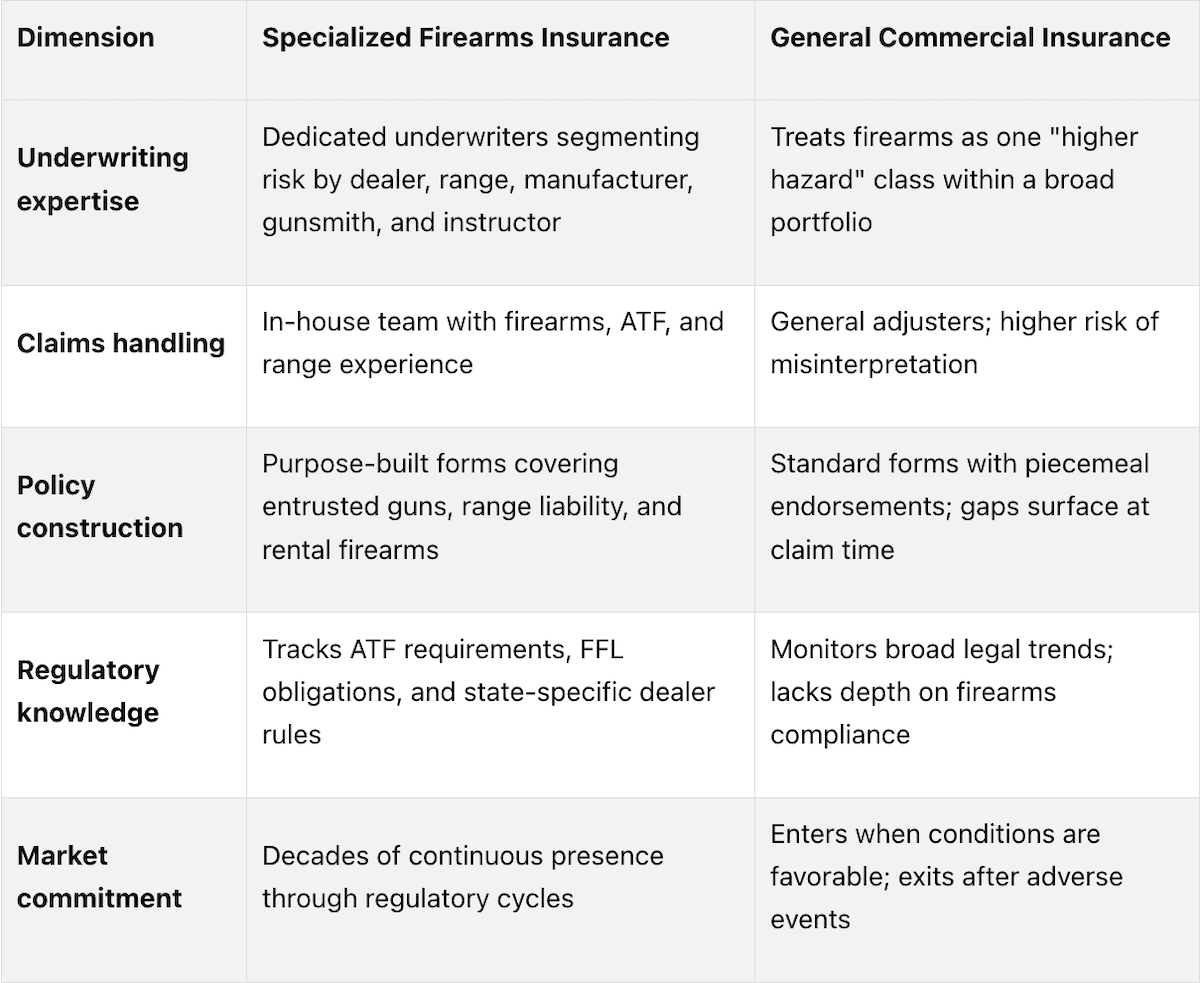
Joseph Chiarello & Co., Inc. (guninsurance.com) is one example of what the specialist column looks like in practice: more than 40 years of uninterrupted firearms industry presence, underwriting depth across every segment, and over 3,000 firearms businesses insured nationwide. [9][4]
Use these markers to review your current policy before renewal or after a loss exposes the gaps.
If your current policy fails these checks, the next step is reviewing it before renewal or before a claim puts the weak spots on full display.
Most firearms business owners don’t study their policy until something goes sideways. And that’s usually the worst time to find a gap.
A review before renewal, not after a claim, is the smart move. Start with the policy language. Then check classification. Then look at limits. The goal isn’t the cheapest premium. It’s making sure the coverage actually fits the business.
Pull the full policy and every endorsement. Then check for issues like:
Also confirm that property limits still match current inventory. That’s where problems often hide, quietly, until a loss brings them into the open.
A fast way to test specialization is simple: look at how the carrier writes the policy and how it handles the claim.
A specialist is more than a company that advertises to firearms businesses. The difference shows up in three places: underwriting questions, claims staffing, and policy forms that directly name firearms exposures.
One clear example of that standard is a specialist with long, uninterrupted firearms-market experience. Joseph Chiarello & Co., Inc. (guninsurance.com) has maintained uninterrupted firearms industry presence for over 40 years, serves more than 3,000 firearms businesses nationwide, and handles claims in-house with staff who understand ATF reporting, FFL obligations, and the liability patterns specific to range operations, gunsmithing, and retail sales. Underwriting spans every segment of the industry, so mixed operations don’t fall through classification cracks. [4][3] Use that profile as the benchmark when you compare any carrier.
These failures keep showing up for the same reasons: generic underwriting, retrofitted forms, weak regulatory knowledge, and carriers that leave when the market shifts. Firearms businesses can break that pattern by choosing carriers based on specialization, stability, and policy design - not price alone.
You often learn this the hard way at claim time. The claim gets denied or held up because the firearms risk wasn’t rated or described the right way under your liability, property, or transit coverage. In some cases, an exclusion kicks in.
Look closely for gaps between what your business does - FFL activity, ranges, gunsmithing, inventory, and shipping - and how the policy says your coverage works. It also helps to confirm that compliance-related coverage depends on accurate documentation and proper storage and security practices.
Firearms businesses often leave major gaps in their insurance.
The most common misses include:
Another issue is limits that don’t go far enough. A business may carry general liability, but the coverage cap can be too low if a large claim hits. Some also skip umbrella coverage, which can leave them exposed once primary limits run out.
Transit and inland shipping coverage is another trouble spot. Standard policies may exclude firearms, parts, and ammunition during transit, or they may cap coverage at levels that don’t match the shipment’s actual value.
Look for deep, long-term firearms industry experience, not just marketing polish. A true specialist has a steady track record in the space, understands ATF rules and state-by-state requirements, uses policy language built for this industry, and handles claims in-house with adjusters who know how the business works.
It also helps to check the carrier’s underwriting strength across manufacturing, retail, and shooting ranges. That way, your actual exposures, not just broad business risks, are addressed the way they should be.
Don't wait until it's too late to make sure your gun shop is covered. At Joseph Chiarello & Co., Inc., we’re here to help you navigate the ins and outs of gun shop workers compensation insurance to ensure you're prepared for any noise-related risks, including hearing damage. Reach out to us today to review your current policy or get a customized quote. Protect your team and your business with the right coverage—because their safety is worth it.
Call Now: 800-526-2199. Or submit your inquiry below. We look forward to having the opportunity to work with you!